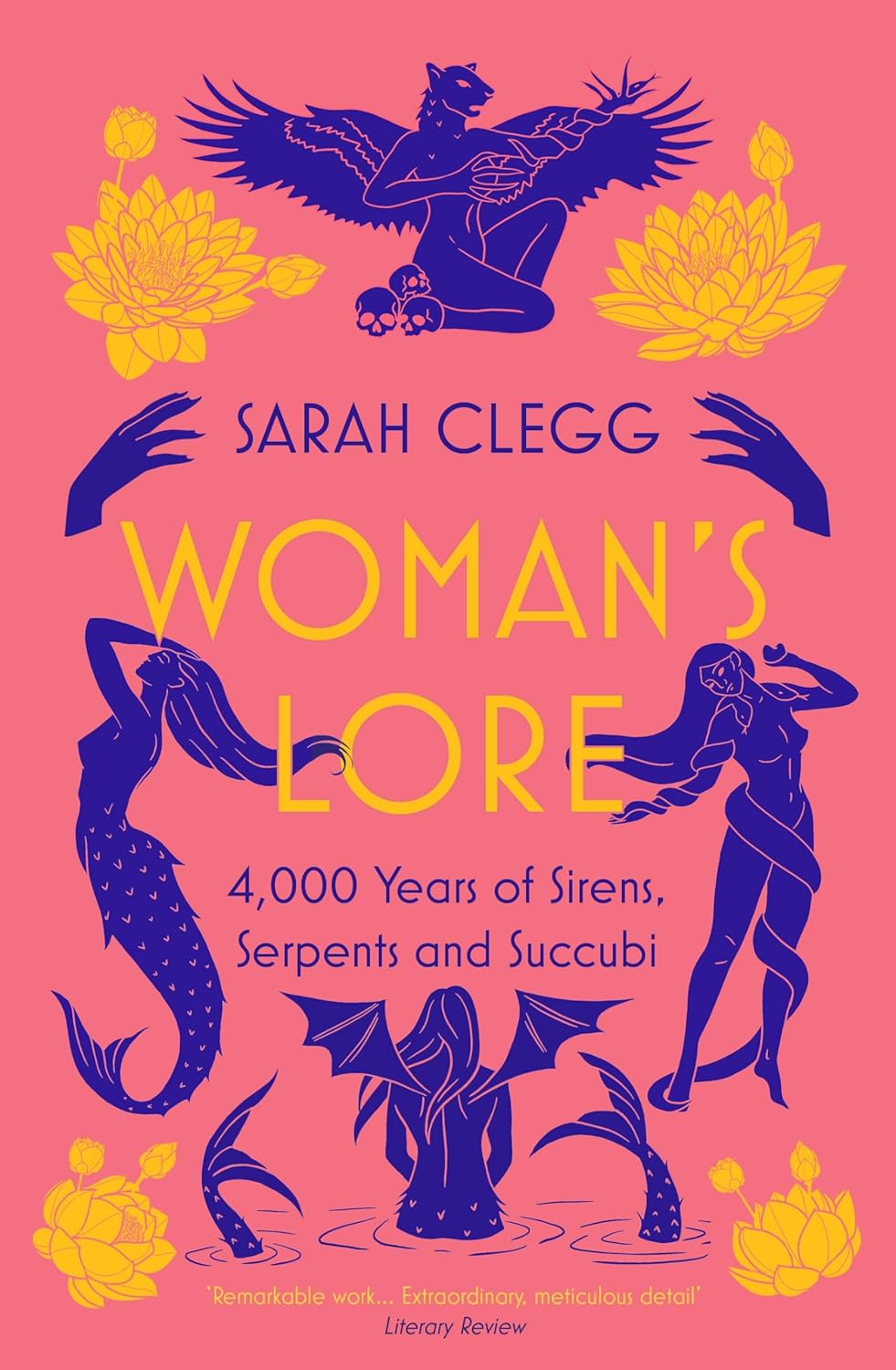

M. J. Wright reviewed Woman's Lore by Sarah Clegg
A Thread Through Time.
3 stars
When I came across Woman’s Lore, I was looking into all sorts of bestiaries and mythological legends to help with a book I’m (trying) to write. So the subtitle caught my gaze: “4,000 Years of Sirens, Serpents, and Succubi.” I leaned in and spoke to the inanimate object we call a book and said, “Go on.”
Along with being a very interesting thread through history, I also came to realize that this book was a social commentary on how this particular lineage of myths played a part in shaping the perception of the world and its women through the ages.
From Lamashtu to Lilith, from the Gallo to Lamia, we’re shown the struggle between child-eating demons coping with loss through revenge and the wards meant to protect mothers and their children. Further still, we’re told about Lilith’s inception and her well-known(ish) fall from grace, and much more. (Also …
When I came across Woman’s Lore, I was looking into all sorts of bestiaries and mythological legends to help with a book I’m (trying) to write. So the subtitle caught my gaze: “4,000 Years of Sirens, Serpents, and Succubi.” I leaned in and spoke to the inanimate object we call a book and said, “Go on.”
Along with being a very interesting thread through history, I also came to realize that this book was a social commentary on how this particular lineage of myths played a part in shaping the perception of the world and its women through the ages.
From Lamashtu to Lilith, from the Gallo to Lamia, we’re shown the struggle between child-eating demons coping with loss through revenge and the wards meant to protect mothers and their children. Further still, we’re told about Lilith’s inception and her well-known(ish) fall from grace, and much more. (Also the little mermaid is there.) It’s definitely an interesting book that I read cover to cover.
However, unfortunately, I had some issues with this book—not about the subject matter, but about the pacing. There were times where the book slows to a crawl, reiterating on the myths more than I felt was necessary, which in turn made me feel like I was doing the salsa: two steps forward, one step back, step to the left—you get the gist. So even though I found it fascinating, there were days where I just had to put it down, walk away, read a page, and repeat until the tempo picked up again.
Now, when I read something interesting that I want to remember—references for further reading, something to look up, or an idea for my own writing—I add a sticky note. For this book, the majority of my stickies are in two chapters: “The Other Woman” (p. 115) and “The Monster Outside” (p. 189). I couldn’t tell you why those chapters in particular, but inspiration works in mysterious ways. If I had to guess, Lilith was something I knew very little about outside the “main story,” and that chapter made me want to know more—she has way more facets than one would imagine at first glance (no surprise many wrote tales including her, someone like her, or people named after her). And for the other chapter, it’s probably due to its contemporary nature—the aftershocks of the 19th century still billow through to today.
All in all, if you’re a strong reader and can push yourself through some of the slower sections, Woman’s Lore is definitely worth a read. Clegg wove a thread that I didn’t know about before, and that’s valuable.
Take care. —MJW