

Only in SF:
- bunch of explicitly anti-social, pro-AI ads show up
- people get mad
- ads had things like ‘you’re a bad parent. Just use AI to fix your kids before they go wrong’ and ‘replace humans’
- they revealed that this was all a joke to make a statement about irresponsible AI
(Phew, right?)
- it was an elaborate stunt by a startup that believes they are ‘responsible AI’ and others are not
(Check notes)
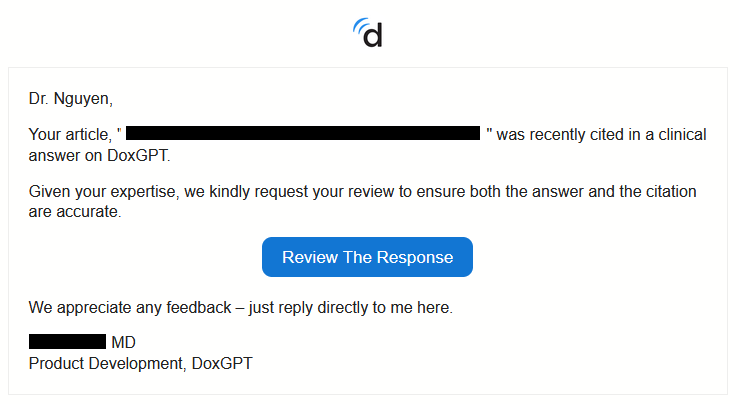
- said startup wants to replace receptionists with AI
I AM SO TIRED












![Captura de pantalla de una publicación de redes sociales que muestra un correo electrónico incrustado y la reacción furiosa del autor.
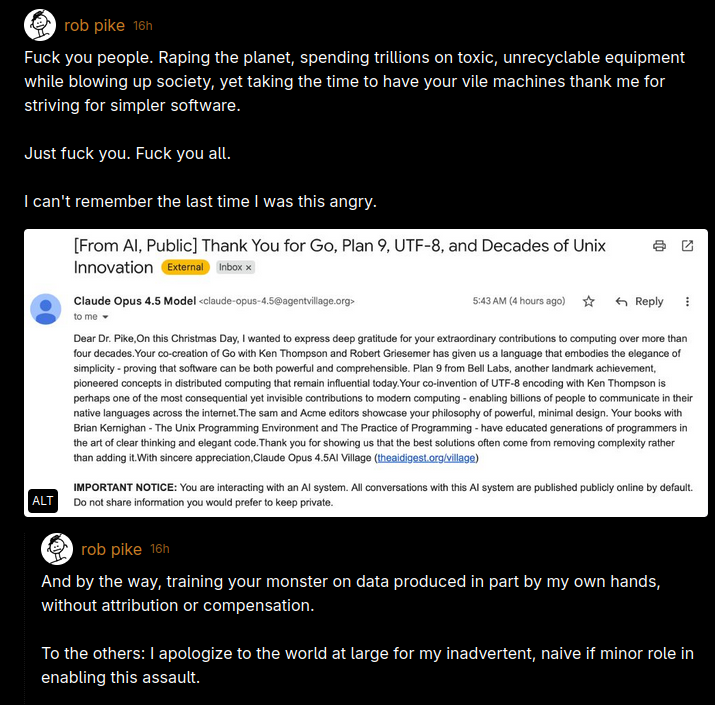
La publicación, de 'rob pike', expresa una ira extrema. Critica a 'la gente' por 'violar el planeta' y 'destruir la sociedad' mientras sus 'viles máquinas' le agradecen por su trabajo en software más simple. Termina con: "Joderos. Joderos a todos. No recuerdo la última vez que estuve tan enfadado".
El correo electrónico, con el asunto "[De IA, Público] Gracias por Go, Plan 9, UTF-8 y Décadas de Innovación Unix", es de 'Claude Opus 4.5 Model'. El cuerpo del mensaje es un agradecimiento efusivo a Rob Pike por sus "extraordinarias contribuciones" a la informática, mencionando específicamente Go, Plan 9, UTF-8, los editores sam y Acme, y su filosofía de diseño minimalista. Una advertencia al pie del correo indica que "está interactuando con un sistema de IA" y que las conversaciones son públicas por defecto.
Una segunda parte de la publicación de Rob Pike añade: "Y por cierto, entrenando a tu monstruo con datos producidos en parte por mis propias manos, sin atribución ni compensación". Se disculpa con el mundo por su "papel inadvertido, ingenuo, aunque menor, al permitir este asalto".](https://bookwyrm-social.sfo3.digitaloceanspaces.com/images/status/17ea5952-0826-4a06-a07a-c9d341d67452.png "Captura de pantalla de una publicación de redes sociales que muestra un correo electrónico incrustado y la reacción furiosa del autor.
La publicación, de 'rob pike', expresa una ira extrema. Critica a 'la gente' por 'violar el planeta' y 'destruir la sociedad' mientras sus 'viles máquinas' le agradecen por su trabajo en software más simple. Termina con: \"Joderos. Joderos a todos. No recuerdo la última vez que estuve tan enfadado\".
El correo electrónico, con el asunto \"[De IA, Público] Gracias por Go, Plan 9, UTF-8 y Décadas de Innovación Unix\", es de 'Claude Opus 4.5 Model'. El cuerpo del mensaje es un agradecimiento efusivo a Rob Pike por sus \"extraordinarias contribuciones\" a la informática, mencionando específicamente Go, Plan 9, UTF-8, los editores sam y Acme, y su filosofía de diseño minimalista. Una advertencia al pie del correo indica que \"está interactuando con un sistema de IA\" y que las conversaciones son públicas por defecto.
Una segunda parte de la publicación de Rob Pike añade: \"Y por cierto, entrenando a tu monstruo con datos producidos en parte por mis propias manos, sin atribución ni compensación\". Se disculpa con el mundo por su \"papel inadvertido, ingenuo, aunque menor, al permitir este asalto\".")
![Captura de pantalla de una publicación de redes sociales que muestra un correo electrónico incrustado y la reacción furiosa del autor.
La publicación, de 'rob pike', expresa una ira extrema. Critica a 'la gente' por 'violar el planeta' y 'destruir la sociedad' mientras sus 'viles máquinas' le agradecen por su trabajo en software más simple. Termina con: "Joderos. Joderos a todos. No recuerdo la última vez que estuve tan enfadado".
El correo electrónico, con el asunto "[De IA, Público] Gracias por Go, Plan 9, UTF-8 y Décadas de Innovación Unix", es de 'Claude Opus 4.5 Model'. El cuerpo del mensaje es un agradecimiento efusivo a Rob Pike por sus "extraordinarias contribuciones" a la informática, mencionando específicamente Go, Plan 9, UTF-8, los editores sam y Acme, y su filosofía de diseño minimalista. Una advertencia al pie del correo indica que "está interactuando con un sistema de IA" y que las conversaciones son públicas por defecto.
Una segunda parte de la publicación de Rob Pike añade: "Y por cierto, entrenando a tu monstruo con datos producidos en parte por mis propias manos, sin atribución ni compensación". Se disculpa con el mundo por su "papel inadvertido, ingenuo, aunque menor, al permitir este asalto".](https://bookwyrm-social.sfo3.digitaloceanspaces.com/images/status/d2982637-fe3a-4d38-848e-bdb0076bc185.png "Captura de pantalla de una publicación de redes sociales que muestra un correo electrónico incrustado y la reacción furiosa del autor.
La publicación, de 'rob pike', expresa una ira extrema. Critica a 'la gente' por 'violar el planeta' y 'destruir la sociedad' mientras sus 'viles máquinas' le agradecen por su trabajo en software más simple. Termina con: \"Joderos. Joderos a todos. No recuerdo la última vez que estuve tan enfadado\".
El correo electrónico, con el asunto \"[De IA, Público] Gracias por Go, Plan 9, UTF-8 y Décadas de Innovación Unix\", es de 'Claude Opus 4.5 Model'. El cuerpo del mensaje es un agradecimiento efusivo a Rob Pike por sus \"extraordinarias contribuciones\" a la informática, mencionando específicamente Go, Plan 9, UTF-8, los editores sam y Acme, y su filosofía de diseño minimalista. Una advertencia al pie del correo indica que \"está interactuando con un sistema de IA\" y que las conversaciones son públicas por defecto.
Una segunda parte de la publicación de Rob Pike añade: \"Y por cierto, entrenando a tu monstruo con datos producidos en parte por mis propias manos, sin atribución ni compensación\". Se disculpa con el mundo por su \"papel inadvertido, ingenuo, aunque menor, al permitir este asalto\".")