
"#DavidGraeber was the #anthropologist who re-framed economics by showing that its most basic assumptions were myths.
Where conventional economists traced money to barter and exchange, #Graeber traced it to trust and relationships. He argued that the origins of money lay not in #markets but in #morality: in obligations, promises, and the human capacity for cooperation."
#davidgraeber
See tagged statuses in the local BookWyrm community

Someone recommended David Graeber's book The Utopia of Rules: On Technology, Stupidity, and the Secret Joys of Bureaucracy to me, & I did not expect from the title exactly how incisive a leftist critique it is.
I highly recommend it to anyone who wants to understand the structural violence hidden within bureaucracy.
Someone recommended David Graeber's book The Utopia of Rules: On Technology, Stupidity, and the Secret Joys of Bureaucracy to me, & I did not expect from the title exactly how incisive a leftist critique it is.
I highly recommend it to anyone who wants to understand the structural violence hidden within bureaucracy.

Has anyone written about / applied #DavidGraeber & #DavidWengrow's three basic forms of social #freedom to #technology and/or #SocialMedia? I'd love to read this.
- the freedom to escape one's surroundings and move away,
- the freedom to disobey arbitrary authority, and
- the freedom to reimagine and reconstruct one's society in a different form.
Has anyone written about / applied #DavidGraeber & #DavidWengrow's three basic forms of social #freedom to #technology and/or #SocialMedia? I'd love to read this.
- the freedom to escape one's surroundings and move away,
- the freedom to disobey arbitrary authority, and
- the freedom to reimagine and reconstruct one's society in a different form.

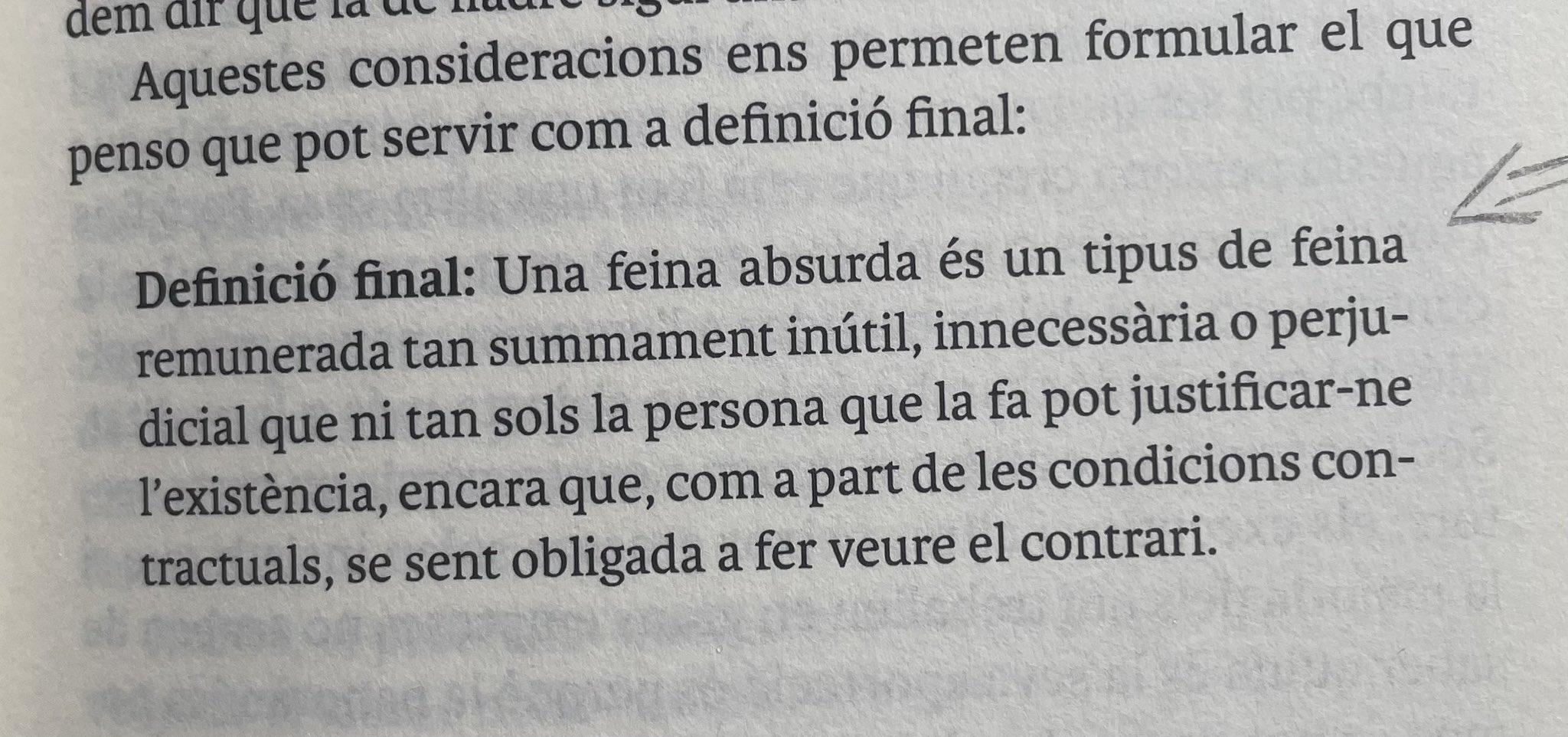
👉🏽Quantes feines absurdes fem en la universitat?
Vegeu-ne la definició de #DavidGraeber
https://descontrol.cat/portfolio/feines-absurdes/


"No dia de hoje, lamentamos o falecimento de nosso amigo e camarada David Graeber, um pensador incansável, perspicaz e abrangente. Em sua homenagem, apresentamos seu ensaio, “O Choque da Vitória”, que ele compôs para a quinta edição de nossa revista, Rolling Thunder, explorando como anarquistas podem estabelecer metas de longo prazo para não seremos surpreendidas por nossas vitórias ."
https://pt.crimethinc.com/2020/09/07/o-choque-da-vitoria-um-ensaio-por-david-graeber-e-um-breve-elogio-a-ele
#anarquismo #davidgraeber

Onte rematei “Trabajos de mierda” de David Graeber. Para min libro imprescindibel para entender o mercado laboral contemporáneo que só beneficia ás elites.


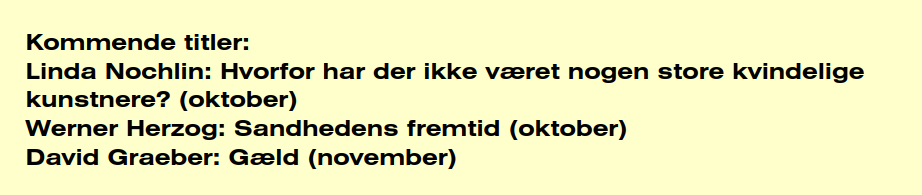
Jeg har sendt manuskriptet for oversættelsen af David Graebers "Gæld - De første 5.000 år" til korrektur i aften. Det er en kæmpe milepæl i et af de måske længstvarende projekter i mit liv. Nu kører vi efter at få den udgivet til vinter på forlaget A Mock Book. Jeg håber der bliver taget godt imod den, især at den blevet diskuteret, analyseret og kritiseret. Efter så mange års arbejde, er den for mig stadig en guldgrube af idéer og historier.
Recién recogidos en @Delirio 💜📚


Today’s book purchases, in an attempt to combat hopelessness. #MarkFisher #DavidGraeber #Anarchism #bookstodon


Audiolibro:
Fragmentos de antropología anarquista - David Graeber

The anthropologist Marshall Sahlins, surveying the data on contemporary hunter-gatherers, exploded the Hobbesian myth in an article entitled "The Original Affluent Society." They work a lot less than we do, and their work is hard to distinguish from what we regard as play. Sahlins concluded that "hunters and gatherers work less than we do; and rather than a continuous travail, the food quest is intermittent, leisure abundant, and there is a greater amount of sleep in the daytime per capita per year than in any other condition of society." They worked an average of four hours a day, assuming they were "working" at all. Their "labor," as it appears to us, was skilled labor which exercised their physical and intellectual capacities...
-David Graeber
#anarchy #anarchism #anarchist #communist #communism #socialist #socialism #socialecology #solarpunk …
The anthropologist Marshall Sahlins, surveying the data on contemporary hunter-gatherers, exploded the Hobbesian myth in an article entitled "The Original Affluent Society." They work a lot less than we do, and their work is hard to distinguish from what we regard as play. Sahlins concluded that "hunters and gatherers work less than we do; and rather than a continuous travail, the food quest is intermittent, leisure abundant, and there is a greater amount of sleep in the daytime per capita per year than in any other condition of society." They worked an average of four hours a day, assuming they were "working" at all. Their "labor," as it appears to us, was skilled labor which exercised their physical and intellectual capacities...
-David Graeber
#anarchy #anarchism #anarchist #communist #communism #socialist #socialism #socialecology #solarpunk #SolarPunkSunday #DavidGraeber

Happy Earth Day.
Less is more, or as David Graeber put it:
https://theanarchistlibrary.org/library/david-graeber-to-save-the-world-we-re-going-to-have-to-stop-working #EarthDay #DavidGraeber #Anarchism

"Our feelings of helplessness stem from the fact that for thirty years the tools of persuasion and coercion have been mobilized to wage an ideological war for capitalism, rather than to create conditions for capitalism to remain viable." -David Graeber
#Propaganda #Socialism #Inequality #Philosophy #DavidGraeber

"Talking about rational efficiency becomes a way of avoiding talking about what the efficiency is actually for."
~ David Graeber, 2015, The Utopia of Rules
#DavidGraeber #freemarket
"Whenever someone starts talking about the 'free market' it's a good idea to look around for the man with the gun."
~ David Graeber, 2015, The Utopia of Rules
#DavidGraeber #freemarket
"Whenever someone starts talking about the 'free market' it's a good idea to look around for the man with the gun."
~ David Graeber, 2015, The Utopia of Rules
#DavidGraeber #freemarket