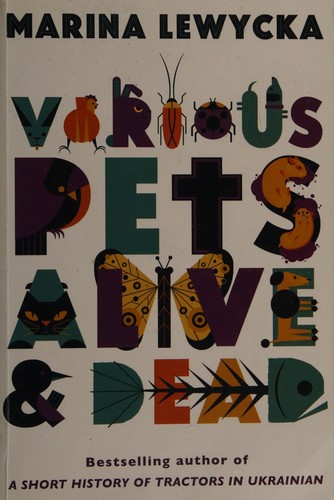

Stephen Hayes reviewed Various pets alive and dead by Marina Lewycka
None
4 stars
In many ways this is a novel for our time, a novel of our time. It's about the generation gap, which has become inverted for the generation that invented (or provoked) the term "generation gap". That's my generation.
Marcus and Dora were part of a left-wing commune in the 1960s and 1970s and hoped that their children would grow up to share their ideals. Their daughter Clara is a teacher of rather prosaic subjects, but at least she is teaching working-class kids. Their mathematically-gifted son Serge, they believe, is working on a PhD in Cambridge, and seems set for a career of pure research, which will not prop up the blood-sucking capitalist system. What they do not know, and what he is too afraid to tell them, is that he has been head-hunted as a risk analyst by a firm of high-flying financiers, and is helping them to ride the …
In many ways this is a novel for our time, a novel of our time. It's about the generation gap, which has become inverted for the generation that invented (or provoked) the term "generation gap". That's my generation.
Marcus and Dora were part of a left-wing commune in the 1960s and 1970s and hoped that their children would grow up to share their ideals. Their daughter Clara is a teacher of rather prosaic subjects, but at least she is teaching working-class kids. Their mathematically-gifted son Serge, they believe, is working on a PhD in Cambridge, and seems set for a career of pure research, which will not prop up the blood-sucking capitalist system. What they do not know, and what he is too afraid to tell them, is that he has been head-hunted as a risk analyst by a firm of high-flying financiers, and is helping them to ride the rough seas of the financial crisis of 2008, and is what they would regard as immorally rich, and getting richer. His parents' values and his upbringing give him occasional twinges of conscience, but he manages to suppress them quite easily, for the most part. He is a bit more worried about getting caught.
The third child, Oolie-Anna, has Down's syndrome, and so lives at home, but her social worker keeps urging that she move out and become independent, because her aging parents will not be able to look after her for ever.
I read [b:A short history of tractors in Ukrainian|828387|A Short History of Tractors in Ukrainian|Marina Lewycka|https://d202m5krfqbpi5.cloudfront.net/books/1327935785s/828387.jpg|4240781] by [a:Marina Lewycka|41814|Marina Lewycka|https://d202m5krfqbpi5.cloudfront.net/authors/1253836073p2/41814.jpg] about seven years ago. That was mainly about Ukrainian immigrants who had settled in Britain, and was both funny and sad.
This one is also funny and sad, but the main characters are British, and there is only one Ukrainian, who is not a viewpoint character. The viewpoint moves mostly between Doro, the mother, and her two children Clara and Serge, with Marcus having his say much more rarely. There is thus no protagonist, or perhaps one could say no human protagonist, because the real protagonist is the new capitalism, and its effects on its devotees and its victims.
It is set in Britain, but the kind of values it represents are very much evident in South Africa today as well.