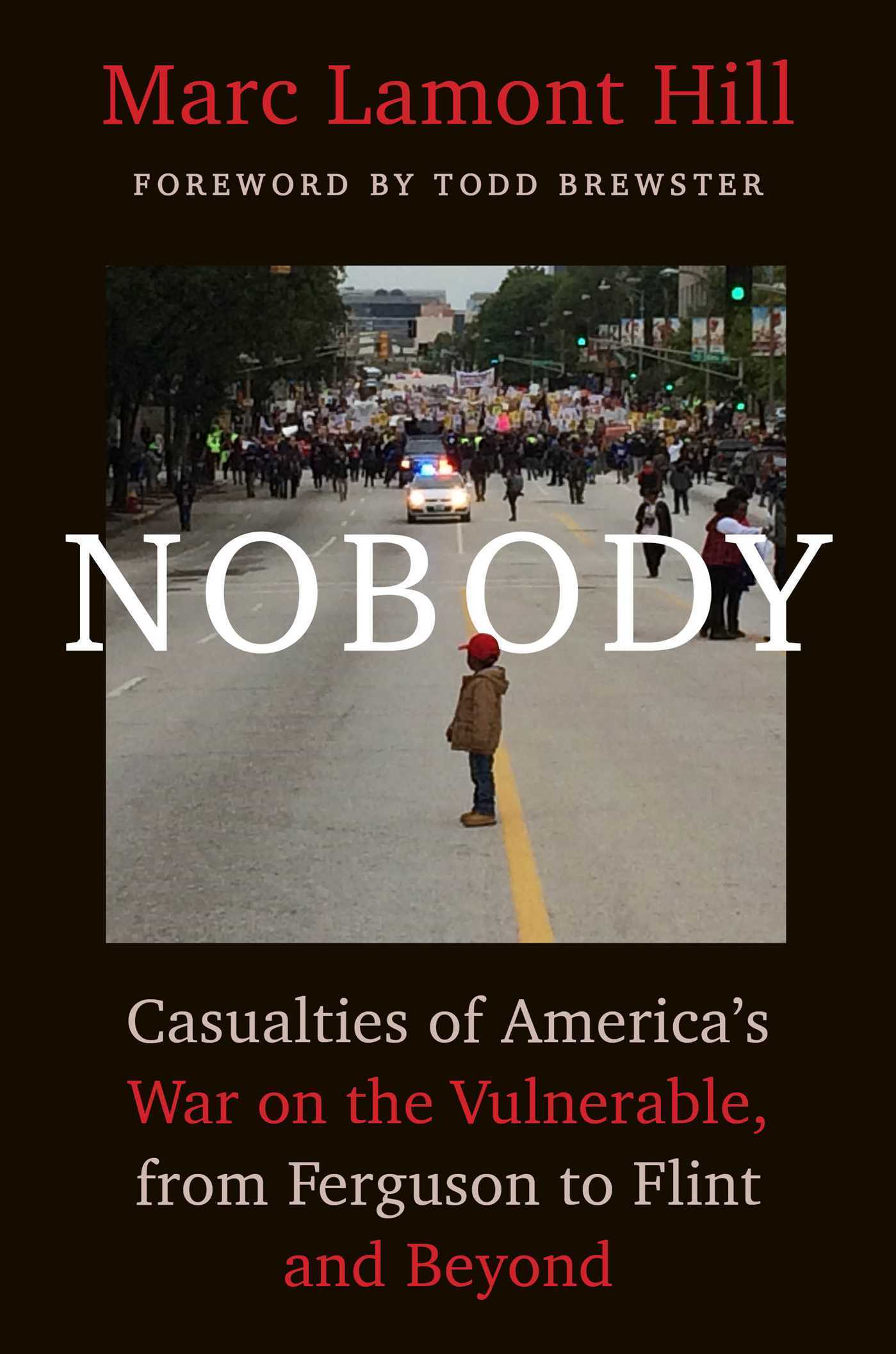
In this “thought-provoking and important” (Library Journal) analysis of state-sanctioned violence, Marc Lamont Hill carefully considers a string of high-profile deaths in America—Sandra Bland, Freddie Gray, Michael Brown, Eric Garner, Trayvon Martin, and others—and incidents of gross negligence by government, such as the water crisis in Flint, Michigan.
He digs underneath these events to uncover patterns and policies of authority that allow some citizens become disempowered, disenfranchised, poor, uneducated, exploited, vulnerable, and disposable. To help us understand the plight of vulnerable communities, he examines the effects of unfettered capitalism, mass incarceration, and political power while urging us to consider a new world in which everyone has a chance to become somebody.
Heralded as an essential text for our times, Marc Lamont Hill’s galvanizing work embodies the best traditions of scholarship, journalism, and storytelling to lift unheard voices and to address the necessary question, “how did we get here?"
…
In this “thought-provoking and important” (Library Journal) analysis of state-sanctioned violence, Marc Lamont Hill carefully considers a string of high-profile deaths in America—Sandra Bland, Freddie Gray, Michael Brown, Eric Garner, Trayvon Martin, and others—and incidents of gross negligence by government, such as the water crisis in Flint, Michigan.
He digs underneath these events to uncover patterns and policies of authority that allow some citizens become disempowered, disenfranchised, poor, uneducated, exploited, vulnerable, and disposable. To help us understand the plight of vulnerable communities, he examines the effects of unfettered capitalism, mass incarceration, and political power while urging us to consider a new world in which everyone has a chance to become somebody.
Heralded as an essential text for our times, Marc Lamont Hill’s galvanizing work embodies the best traditions of scholarship, journalism, and storytelling to lift unheard voices and to address the necessary question, “how did we get here?"
Named a Best Book of the Year by Kirkus Reviews
A New York Times Editor’s Choice
Nautilus Award Winner
“A worthy and necessary addition to the contemporary canon of civil rights literature.” —The New York Times
From one of the leading voices on civil rights in America, a thoughtful and urgent analysis of recent headline-making police brutality cases and the systems and policies that enabled them.
An excellent history of the criminal justice system and racial disparities in America, and how its failures and systemic racism led to recent tragedies. I honestly think everyone in America should read this book.
A wide-ranging book that dips into some of the ways that the powerful oppress the less powerful in America. I already agreed with the author on the issues. It seems like someone who doesn't, but is genuinely interested in learning about the issues, would not be turned off by the tone.
I'm not sure I've gained much more new insight from reading the book. But I think this book ties together a lot of points well, which helps me think and talk about these things in an orderly way. I think that's pretty valuable.
A wide-ranging book that dips into some of the ways that the powerful oppress the less powerful in America. I already agreed with the author on the issues. It seems like someone who doesn't, but is genuinely interested in learning about the issues, would not be turned off by the tone.
I'm not sure I've gained much more new insight from reading the book. But I think this book ties together a lot of points well, which helps me think and talk about these things in an orderly way. I think that's pretty valuable.