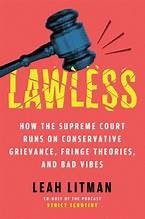
Justin reviewed Lawless by Leah Litman
Good Assessment of where the Court stands in 2025
4 stars
I picked up this book after Litman promoted it on her podcast, Strict Scrutiny. The writing is just as rapid and referential to pop culture as her typical speech is, which makes for a relatively engaging way to read about legal matters.
The book gives an extensive, broad overview of how the Supreme Court has wielded its power for partisan and non-democratic ends, spanning from early in our nation's history to the court as it exists under Chief Justice John Roberts (more focus given to this latest era). Litman shows that the idea of an apolitical court practising blind justic is entirely false—the court and its justices are political actors like any other official, and she details how the conservative legal movement specifically crafted a strategy around this fact to advance minority political views into the legal status-quo against popular will. She discusses how the court's decisions have affect …
I picked up this book after Litman promoted it on her podcast, Strict Scrutiny. The writing is just as rapid and referential to pop culture as her typical speech is, which makes for a relatively engaging way to read about legal matters.
The book gives an extensive, broad overview of how the Supreme Court has wielded its power for partisan and non-democratic ends, spanning from early in our nation's history to the court as it exists under Chief Justice John Roberts (more focus given to this latest era). Litman shows that the idea of an apolitical court practising blind justic is entirely false—the court and its justices are political actors like any other official, and she details how the conservative legal movement specifically crafted a strategy around this fact to advance minority political views into the legal status-quo against popular will. She discusses how the court's decisions have affect voting rights, reproductive rights, gender equality, the capabilities of the regulatory state, and the general health of our constitutional order.
There is one aspect of the book I found sightly frustrating. Litman references a seemingly countless number of legal cases and political events; although she often gets her point across, there are many cases where almost no details beyond the conclusion of the case/outcome of the politicking.
I would recommend this book to anyone who wants to know how the court is political in nature.