
None
3 stars
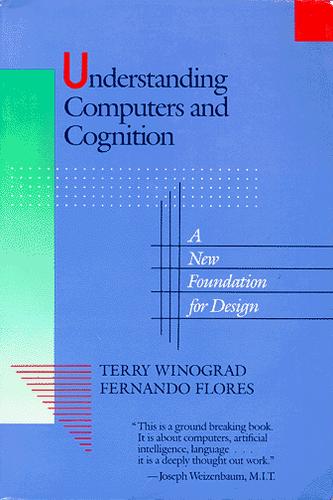
The books theory is based on phenomenology (Heidegger, Gadamer). Artificial intelligence and design are discussed based on the philosophy’s implications. The introduced concepts of Heidegger’s ready-to-hand and breakdown. It also discusses tacit assumptions in our use of language, showing that the truth of a statement is dependent on these assumptions and that the assumptions themselves are constantly (re)created in our use of language and actions.
There are references to Wittgenstein (who is relevant for his “Sprachspiele” in this context) and Garfinkel (who is relevant for his discussion of “Accountability”), however, they are less extensive than I expected in a book discussing language and social commitments extensively.
The non-philosophical parts were interesting, but very short. The implications for design are discussed explicitly only in the last chapter (although greatly interweaving the theoretical ideas as well as actual products illustrating the ideas). The sections on Artificial Intelligence are still interesting, however, the …
The books theory is based on phenomenology (Heidegger, Gadamer). Artificial intelligence and design are discussed based on the philosophy’s implications. The introduced concepts of Heidegger’s ready-to-hand and breakdown. It also discusses tacit assumptions in our use of language, showing that the truth of a statement is dependent on these assumptions and that the assumptions themselves are constantly (re)created in our use of language and actions.
There are references to Wittgenstein (who is relevant for his “Sprachspiele” in this context) and Garfinkel (who is relevant for his discussion of “Accountability”), however, they are less extensive than I expected in a book discussing language and social commitments extensively.
The non-philosophical parts were interesting, but very short. The implications for design are discussed explicitly only in the last chapter (although greatly interweaving the theoretical ideas as well as actual products illustrating the ideas). The sections on Artificial Intelligence are still interesting, however, the book is dated and the systems discussed use different paradigms than the ones today.
Related for their criticism of rationalist ideas: Supersizing the mind (Clark), The Reflective Practitioner (Schön), Plans and Situated actions (Suchman)