

I really enjoyed this as my first introduction to category theory. If you're looking for something that's fun and useful to read without taking it very seriously this is a great book to read. You can still get a lot out of just doing the exercises that you think are neat and trying to loosely follow the constructions.
This book made me feel comfortable talking about categories and put me in a good place to start reading other topics. I particularly enjoyed chapter 7 and the introduction to sheaves.
User Profile
This link opens in a pop-up window
Lulululu's books
User Activity
RSS feed Back
Lulululu stopped reading

Eiichiro Oda: Romance dawn. (GraphicNovel, 2003, Viz)
Romance dawn. by Eiichiro Oda (One piece -- Volume 1)
Monkey D. Luffy, who can stretch his body like rubber, is searching for a treasure called One Piece that was …
Lulululu stopped reading
None
5 stars
I really enjoyed this as my first introduction to category theory. If you're looking for something that's fun and useful to read without taking it very seriously this is a great book to read. You can still get a lot out of just doing the exercises that you think are neat and trying to loosely follow the constructions.
This book made me feel comfortable talking about categories and put me in a good place to start reading other topics. I particularly enjoyed chapter 7 and the introduction to sheaves.
Lulululu reviewed Women by Charles Bukowski

Women is a 1978 novel written by Charles Bukowski, starring his semi-autobiographical character Henry Chinaski. …
None
Women tells the numerous stories of Hank Chinaski's "experiences" with women; the word misogyny doesn't do enough justice. That's about it. You get some exposition in the beginning of who Chinaski is, then you are taken through 104 chapters of abuse, rape, and Chinaski feeling sorry for himself. Then with an ambiguous final chapter it's over. If you find interest in the way Chinaski thinks, I believe you will find interest this book. Keep in mind, the book is semi-autobiographical taking experiences from Bukowskis life and writing them into the character Chinaski. A similar book is No Longer Human by Osamu Dazai. You may like one if and only if you like the other.
While No Longer Human tells a story of a person over their whole life, Women is like a record on repeat. There is hardly any character development and it seems the author does this because his …
Women tells the numerous stories of Hank Chinaski's "experiences" with women; the word misogyny doesn't do enough justice. That's about it. You get some exposition in the beginning of who Chinaski is, then you are taken through 104 chapters of abuse, rape, and Chinaski feeling sorry for himself. Then with an ambiguous final chapter it's over. If you find interest in the way Chinaski thinks, I believe you will find interest this book. Keep in mind, the book is semi-autobiographical taking experiences from Bukowskis life and writing them into the character Chinaski. A similar book is No Longer Human by Osamu Dazai. You may like one if and only if you like the other.
While No Longer Human tells a story of a person over their whole life, Women is like a record on repeat. There is hardly any character development and it seems the author does this because his novel is just a record of a time in his life. There's a lowly attempt in the last chapter where Chinaski deems himself a good guy for giving food to a stray and deciding "to straighten himself out" for the woman he's currently seeing. There's clearly a contrast in size between this decision occuring in the last few sentences of the book and the other 99% of the novel. It's certainly confusing to interpret; is the author setting up for Chinaski to return to his usual behaviour and saying people like him never change? Is he being hopeful for Chinaski's future? Is he looking for forgiveness from the reader? A mix of both? One would hope the author would have learnt something from these experiences, but based on the lack of character development in Chinaski, one concludes that he (and Bukowski) will go on to continue his affairs will wallowing in self pity.
Lulululu reviewed Atlas of AI by Kate Crawford

The hidden costs of artificial intelligence, from natural resources and labor to privacy, equality, and …
None
5 stars
If you are in STEM or business, READ THIS BOOK.
Can't recommend this book enough. An informative and accessible book on the many issues surrounding AI in the government and business world. Plenty of references for further reading if you're into that. It's very hard to avoid interacting with the many forms of AI, so anyone looking to understand the systems that can be used against them will be satisfied with this book.
If you are in STEM or business, READ THIS BOOK.
Can't recommend this book enough. An informative and accessible book on the many issues surrounding AI in the government and business world. Plenty of references for further reading if you're into that. It's very hard to avoid interacting with the many forms of AI, so anyone looking to understand the systems that can be used against them will be satisfied with this book.
Lulululu rated Man's Search for Meaning: 5 stars
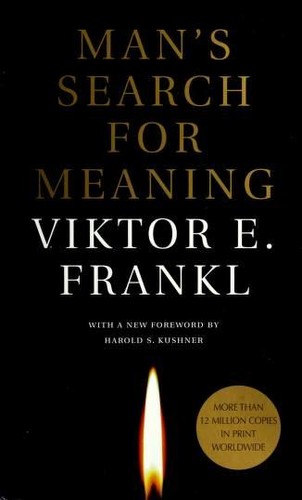
Man's Search for Meaning by Viktor E. Frankl
Psychiatrist Viktor Frankl's memoir has riveted generations of readers with its descriptions of life in Nazi death camps and its …
Lulululu reviewed Death of Ivan Ilych by Leo Tolstoy by Leo Tolstoy
This satirical novella tells the story of the life and early death of a high …
None
5 stars
I quite liked this book because it was short and has themes about death. It also got me interested in Tolstoy's other books - a good introduction!
If you have ever been scared of dying and let it worry you, you might find a lot of the topics discussed in The Death if Ivan Illych familiar. While the author discusses death and it's purpose, I don't think you should go through this book "looking for answers" because Tolstoy doesn't really give you one. Instead, you read about Ivan's spiral as he humours his fears of his impending death. Tolstoy brings up, what I consider to be, typical questions you ask yourself when you're scared of dying: "Why me?" "Why do I have to die?" "Did/am I living my life how inought to?" but never does he really answer them. I think this is to say that these questions don't really …
I quite liked this book because it was short and has themes about death. It also got me interested in Tolstoy's other books - a good introduction!
If you have ever been scared of dying and let it worry you, you might find a lot of the topics discussed in The Death if Ivan Illych familiar. While the author discusses death and it's purpose, I don't think you should go through this book "looking for answers" because Tolstoy doesn't really give you one. Instead, you read about Ivan's spiral as he humours his fears of his impending death. Tolstoy brings up, what I consider to be, typical questions you ask yourself when you're scared of dying: "Why me?" "Why do I have to die?" "Did/am I living my life how inought to?" but never does he really answer them. I think this is to say that these questions don't really have answers anyway, and that Ivan's mental suffering is due to his lack of purpose in living. It's comforting to know that these thoughts bothered the author as he came closer to death, and even more so by the fact that he offers a resolution.
I think many people would enjoy and find meaning in this book. Being only ~90 pages long, I think it's worth anyone's time.
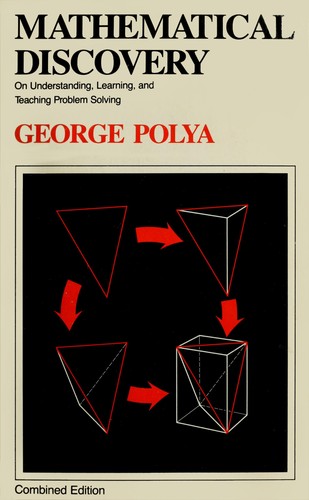
Lulululu reviewed Mathematical discovery by George Pólya
None
4 stars
As a math student about to begin graduate school I enjoyed this book but also found it a little boring. The examples the author gives are nice to keep in your back pocket and his writing style is pleasant and just playful enough to show his personality. That said, I can't help but feel that much of his advice is needlessly repeated throughout each section, which can get a little tiresome. In his defence, the author preaches this teaching technique in the later chapters as a comparison to music and variation on a theme in an effort to find a space of appreciation in the students mind. While I can see this from a lecture perspective, it doesn't work in this book.
If you don't have time for the full book, I would say that volume II outweighs volume I from a teaching perspective. That said, volume I includes perspectives …
As a math student about to begin graduate school I enjoyed this book but also found it a little boring. The examples the author gives are nice to keep in your back pocket and his writing style is pleasant and just playful enough to show his personality. That said, I can't help but feel that much of his advice is needlessly repeated throughout each section, which can get a little tiresome. In his defence, the author preaches this teaching technique in the later chapters as a comparison to music and variation on a theme in an effort to find a space of appreciation in the students mind. While I can see this from a lecture perspective, it doesn't work in this book.
If you don't have time for the full book, I would say that volume II outweighs volume I from a teaching perspective. That said, volume I includes perspectives on problem solving and examples that are classics and serve as great material to give to your students. I was surprised to learn ways to describe methods of problem which I followed subconsciously that I was never aware of.
Lulululu reviewed Galois' dream by Michio Kuga

None
4 stars
I really enjoyed this book and the journey it takes you on. The writing in the earlier chapters is very playful while giving a good introduction and intuition for the fundamental group of a space and covering spaces.
As the book goes on into the complex analysis and fuschian ODEs a lot of the playfulness is dropped and it gets really terse. I would have enjoyed more visuals in this section of the book and found myself looking at different references to understand what was going. I feel I still don't have a good picture in my head of what problems with fuschian ODEs are solved using covering spaces, nor do I feel satisfied in knowing that fuschian ODEs admit solutions in nice functions.
I enjoyed reading this book and it was a great introduction, but I think I will switch to a different book to further study the topics.
I really enjoyed this book and the journey it takes you on. The writing in the earlier chapters is very playful while giving a good introduction and intuition for the fundamental group of a space and covering spaces.
As the book goes on into the complex analysis and fuschian ODEs a lot of the playfulness is dropped and it gets really terse. I would have enjoyed more visuals in this section of the book and found myself looking at different references to understand what was going. I feel I still don't have a good picture in my head of what problems with fuschian ODEs are solved using covering spaces, nor do I feel satisfied in knowing that fuschian ODEs admit solutions in nice functions.
I enjoyed reading this book and it was a great introduction, but I think I will switch to a different book to further study the topics.
Lulululu rated Cognitive Processing Therapy for PTSD: 5 stars

Lulululu rated Three-Body Problem Series: 3 stars
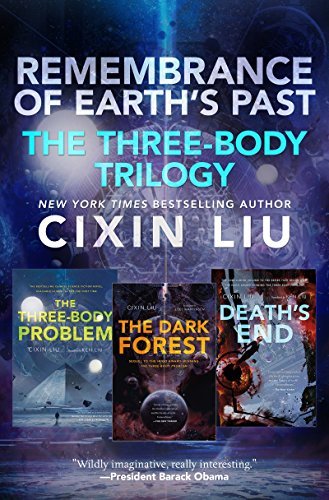
Three-Body Problem Series by Cixin Liu, Ken Liu, Joel Martinsen
This trilogy follows a broad cast of characters through the centuries as earth enters a crisis following the Chinese cultural …
Lulululu reviewed No Longer Human and the Setting Sun by Osamu Dazai
None
5 stars
This book is disgusting. I can't decide what to rate it - the speculation that this book is about the authors life is off putting and has a major effect on how one perceives the book. It's interesting from a psychology POV. I think if you decide to read this book, look up trigger warnings, but also look up what people have to say about the author before and after reading. I don't think this should be read by itself.
This book is disgusting. I can't decide what to rate it - the speculation that this book is about the authors life is off putting and has a major effect on how one perceives the book. It's interesting from a psychology POV. I think if you decide to read this book, look up trigger warnings, but also look up what people have to say about the author before and after reading. I don't think this should be read by itself.
Lulululu rated Mathematical discovery: 4 stars
Lulululu rated How to Do Nothing: 5 stars

How to Do Nothing by Jenny Odell
In a world where addictive technology is designed to buy and sell our attention, and our value is determined by …