Joy101 reviewed Jude the Obscure . By : Thomas Hardy by Thomas Hardy
None
(not provided)
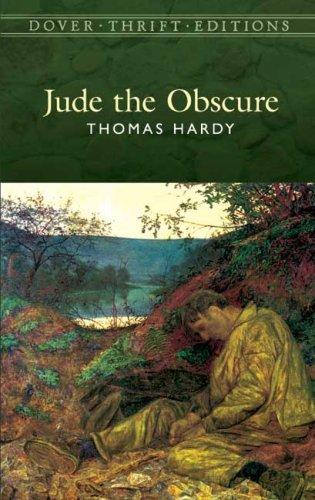
Paperback, 336 pages
English language
Published Dec. 1, 2006 by Dover Publications.
Hardy's last work of fiction, Jude the Obscure is also one of his most gloomily fatalistic, depicting the lives of individuals who are trapped by forces beyond their control. Jude Fawley, a poor villager, wants to enter the divinity school at Christminster. Sidetracked by Arabella Donn, an earthy country girl who pretends to be pregnant by him, Jude marries her and is then deserted. He earns a living as a stonemason at Christminster; there he falls in love with his independent-minded cousin, Sue Bridehead. Out of a sense of obligation, Sue marries the schoolmaster Phillotson, who has helped her. Unable to bear living with Phillotson, she returns to live with Jude and eventually bears his children out of wedlock. Their poverty and the weight of society's disapproval begin to take a toll on Sue and Jude; the climax occurs when Jude's son by Arabella hangs Sue and Jude's children and …
Hardy's last work of fiction, Jude the Obscure is also one of his most gloomily fatalistic, depicting the lives of individuals who are trapped by forces beyond their control. Jude Fawley, a poor villager, wants to enter the divinity school at Christminster. Sidetracked by Arabella Donn, an earthy country girl who pretends to be pregnant by him, Jude marries her and is then deserted. He earns a living as a stonemason at Christminster; there he falls in love with his independent-minded cousin, Sue Bridehead. Out of a sense of obligation, Sue marries the schoolmaster Phillotson, who has helped her. Unable to bear living with Phillotson, she returns to live with Jude and eventually bears his children out of wedlock. Their poverty and the weight of society's disapproval begin to take a toll on Sue and Jude; the climax occurs when Jude's son by Arabella hangs Sue and Jude's children and himself. In penance, Sue returns to Phillotson and the church. Jude returns to Arabella and eventually dies miserably. The novel's sexual frankness shocked the public, as did Hardy's criticisms of marriage, the university system, and the church. Hardy was so distressed by its reception that he wrote no more fiction, concentrating solely on his poetry.Please Note: This book is easy to read in true text, not scanned images that can sometimes be difficult to decipher. The Microsoft eBook has a contents page linked to the chapter headings for easy navigation. The Adobe eBook has bookmarks at chapter headings and is printable up to two full copies per year. Both versions are text searchable.
(not provided)
Thomas Hardy was a great craftsman in the art of writing, and this book is no exception. I love his use of poetic language and how he applies it to characters and their experiences.
I really loved this book’s feel from the beginning, of this obscure boy who nobody wanted who communed with the stars and dreamed of going to Christminster (Hardy’s alias for Oxford). I love how Hardy explores obscure people’s lives and gives them meaning. In addition to being that, this work also feels a bit autobiographical (just guessing).
This book is a direct critique, if not outright attack, on the institution of marriage. I was surprised to read in some of the reviews that there was question as to whether it was moralistic or not. To my eyes it was quite straightforwardly so. The primary moral, which is quite explicitly put forth in great detail by the …
Thomas Hardy was a great craftsman in the art of writing, and this book is no exception. I love his use of poetic language and how he applies it to characters and their experiences.
I really loved this book’s feel from the beginning, of this obscure boy who nobody wanted who communed with the stars and dreamed of going to Christminster (Hardy’s alias for Oxford). I love how Hardy explores obscure people’s lives and gives them meaning. In addition to being that, this work also feels a bit autobiographical (just guessing).
This book is a direct critique, if not outright attack, on the institution of marriage. I was surprised to read in some of the reviews that there was question as to whether it was moralistic or not. To my eyes it was quite straightforwardly so. The primary moral, which is quite explicitly put forth in great detail by the two main characters, is that it is harmful to prevent married people from divorcing (or making it so very onerous as it was in Hardy’s day, regarding the way that society would treat you afterwards).
Besides that moral, there are several other related morals that are less forcefully brought up, and may be considered more as general critiques of how culture handles marriage. It points out that people get married without really knowing what they're doing and for all the wrong reasons, pressure from society, being outright tricked (I'm pregnant...jk), guilt, for appearances, etc. It points out that marrying can have negative effects on one’s love (feelings) for their spouse. It points out that in some circumstances, if you have lived together for long enough and acted married for long enough, it really seems more natural and substantive to consider that person to be married to you rather than someone who you may be married to on paper but haven’t seen in years.
It also shows (and this I found to be valuable) how cruel that society could be in that time toward people who flaunted traditional marriage customs. In one scene, Jude and his not-wife are repairing some stone masonry in a church, in particular, a ten commandments edifice. When some passersby happen upon them doing their work and begin discussing rumors about the couple, this escalates to a certain point, and then the parson has to fire them—not for having done anything wrong, but just for appearance’s sake. He does kindly pay them for the rest of the weeks’ work. But I can imagine how I would feel in that circumstance. There are several other scenes that show them being denied employment and lodging, which affects not just them, but their children, to very cruel effect. It feels quite realistic and I wonder if that is why this book pissed off so many people.
That’s a theme that I see in all of Thomas Hardy’s books that I have read so far: how cruel society can be, how it can even threaten the very survival of people who aren’t conforming to the conventions which are dictated by popular moral ideas. I love Thomas Hardy for exploring that theme. I’m a Christian who, instead of shrinking away from such uncomfortable discussions, wants to lean into them; I find them incredibly important.
My parents divorced when I was 12. It had been a miserable marriage for quite some time leading up till that point. I won’t go into all the details, but suffice it to say, as someone who spends inordinate amounts of time contemplating matters like these, I feel 100% confident that life was better for everyone. Unless an act of God happened, that marriage was not going in a positive direction.
By nature, as a child, I was an idealist. I didn’t want my parents to get divorced, and I felt a sense of wrongness. However, experience has a way of beating down your ideals sometimes. Enough pain over enough time doesn’t necessarily destroy the ideal, it just forces you to accept that the ideal isn’t always a sensible thing to pursue.
So anyways. I don’t approach this question from some naive perspective, happy to hand-wave at others’ suffering as I hold fast to dogma. That’s not where I’m coming from at all. What I am is a seeker of Truth. I really want to know what the Truth is, what Truths can be learned about life and can be applied to questions like these. I’m married right now, have been for 7 years. It’s either the most difficult thing I’ve ever done or the second most (apples and oranges are hard to compare). And this has caused me to examine in an intensely personal philosophic way: what is the purpose of marriage? When is divorce actually helpful?
Here’s what I took away from Hardy’s book.
It’s a broken system when divorced people are treated worse than married people. My dad couldn’t be a deacon in his church simply because he was divorced. There were stigmas toward my mother. There were stigmas toward my family, at my Christian school. It could have been worse. It wasn’t like what Hardy described. But I can get behind this idea of his. It simply is harmful; I don't see a benefit.
I spent some time trying to write about and give my opinions on several other topics related to divorce and marriage, and then quickly discovered I was in over my head. Having thrown away those paragraphs, I will summarize thus. I think Thomas Hardy brings up a lot of real problems with how society handled marriage and divorce, esp in that day, and a couple of fake problems which I thought were red herrings. I also think the book would have benefited from examining the other side of the coin; he never anticipated the counter-arguments and tried to address them, and never gave counter-examples. Where are the happily married couples, or the people who grew to love each other more over time? Curiously, none of those people exist in Hardy's world. So I didn’t find it to be a thorough treatment of the theme.
However, with that said, I think it has a lot of valuable food for discussion and critical reasoning on the topic of marriage and for that reason alone it is a very worthwhile work. It may be that Hardy wasn’t trying to present the other side of the coin because he was writing for a very different audience that was incensed or outraged at things that today are non-problems; their reactions seem bizarre to us. Back then divorce was scandalous to the point of being practically a non-option for most people if they didn’t want to ruin their lives. It wasn’t illegal…it was just that all the societal consequences you would face would be drastic enough to ruin you. That’s not true choice; just the illusion of it. So maybe it made a lot more sense for Hardy to treat the subject that way; he was really trying to make an unpopular point for (in some ways) the first time. So his non-thoroughness can be forgiven.
Today I think our culture is in a very different place, where divorce is often turned to quickly, or even assumed at the onset of marriage. I think a lot of people have lost track of the value of marriage as an instrument for becoming a better person. People have also become less used to pain and difficulty, and no longer see it as the good thing that it truly is. When I’m going through “another fucking growth opportunity,” yes, I don’t have a good attitude often. But in the big picture, this does not change my philosophy on life. I know from countless experiences that I must embrace pain in order to grow, and avoiding pain only causes me to stagnate.
Anyways. There is so much that could be written on this subject and I am certainly not ready to do a thorough treatment of it. So I will stop trying for now and instead simply say that this book by Hardy is good, it is poetic and makes some good points if a bit moralistically in parts, but on the whole it is not so moralistic, but rather just quite focused on showing every problem with the institution of marriage (as implemented in his society) that Hardy could muster. It is also sad, to the point of being depressing in parts. Particularly gruesome is the child suicide/homicide.
Also, I almost forgot to mention one of the themes was the difficulty in being allowed to get a higher education if you weren't born into privilege. I took great interest in seeing how a no-name stonemason would go about trying to get educated in this time period if he were particularly determined. This book answers that question. Spoiler: it sucked.
I am very sorry that he received such intense backlash in his day from this book to the point that he quit writing novels (yes, that was the reason he gave, whether that was a cop-out excuse or not we will never know). I disagree with Hardy on many points about marriage (at least what I think his points were), but I never would have attacked or censored someone for writing a book eloquently making a case that I disagreed with. I’m glad he wrote it and shook up Victorian sensibilities. I’m sad there were no more books after this one.
It shouldn’t have been so controversial as it was. And by that I just mean that I'm against censorship in all its forms. Arguing about controversial topics is essential. Unfortunately, though, most people, when discussing a controversial topic, just resort to dogma instead of a reasoned conversation. I would have loved to engage with Hardy on this topic or any other. I think he was a great man, a reasonable man, and one of those few souls who were gifted with intelligence and compassion in equal measures. Perhaps I’ll meet him in the afterlife and we can argue it out there.
Marriage is drama. Love is drama. Death is drama.
Sue Bridehead is an interesting "strong female character" before her time. Not only challenging in her choices (defying marriage traditions) but also in what she chooses to read--which makes her choices more interesting because she's coming at them from a different moral and intellectual basis. ANd the character of Philloston surprised me as well; he did not follow the tropes I expected.
I don't think Hardy picked a winner in the conflict he identifies between new/urban and old/rural thought and culture. No one in the story is happy, and much harm is done by one "side" to the other. So I get that Hardy is observing the change, but I don't think his conclusions about whether the change is good or bad are apparent.
Sue Bridehead is an interesting "strong female character" before her time. Not only challenging in her choices (defying marriage traditions) but also in what she chooses to read--which makes her choices more interesting because she's coming at them from a different moral and intellectual basis. ANd the character of Philloston surprised me as well; he did not follow the tropes I expected.
I don't think Hardy picked a winner in the conflict he identifies between new/urban and old/rural thought and culture. No one in the story is happy, and much harm is done by one "side" to the other. So I get that Hardy is observing the change, but I don't think his conclusions about whether the change is good or bad are apparent.
3 1/2 stars
Oy vey. I don't know what to think about this book. Kinda liked it, kinda hated it. Sheesh, can it get any more depressing? Talk about a guy who thinks with his d!@#. I hated the character of Sue, what a kook. I hated Arabella too, though. She reminded me of my ex sister-in-law. yeah, that bad.
I have to think about this one for a while.
3 1/2 stars
Oy vey. I don't know what to think about this book. Kinda liked it, kinda hated it. Sheesh, can it get any more depressing? Talk about a guy who thinks with his d!@#. I hated the character of Sue, what a kook. I hated Arabella too, though. She reminded me of my ex sister-in-law. yeah, that bad.
I have to think about this one for a while.
I was disappointed by this. I've not read any other Thomas Hardy works, and was expecting some great stuff here, but I found it mostly soap opera-like, with a weak arc, and not very interesting writing (as compared to, say, Dickens). Also, it has what I see as an excessive tragedy spike late in the novel that is not supported well.
I was disappointed by this. I've not read any other Thomas Hardy works, and was expecting some great stuff here, but I found it mostly soap opera-like, with a weak arc, and not very interesting writing (as compared to, say, Dickens). Also, it has what I see as an excessive tragedy spike late in the novel that is not supported well.
We are so awful; to others and to ourselves. And Hardy has such a keen eye for that wretchedness. OK, that's enough Hardy to last me the next ten years.
We are so awful; to others and to ourselves. And Hardy has such a keen eye for that wretchedness. OK, that's enough Hardy to last me the next ten years.