

Kelson Reads started reading The Wind's Twelve Quarters by Ursula K. Le Guin

The Wind's Twelve Quarters by Ursula K. Le Guin
The Wind's Twelve Quarters is a collection of short stories by American writer Ursula K. Le Guin, named after a …

Techie, software developer, hobbyist photographer, sci-fi/fantasy and comics fan in the Los Angeles area. He/him.
Mostly reading science fiction these days, mixing in some fantasy and some non-fiction (mostly tech and science), occasionally other stuff. As far as books go, anyway. (I read more random articles than I probably should.)
Reviews are cross-posted on my website and I have a blog dedicated to Les Misérables.
Fediverse Main: @kelson@notes.kvibber.com (GoToSocial) Websites: KVibber.com and Hyperborea.org
This link opens in a pop-up window
The Wind's Twelve Quarters is a collection of short stories by American writer Ursula K. Le Guin, named after a …
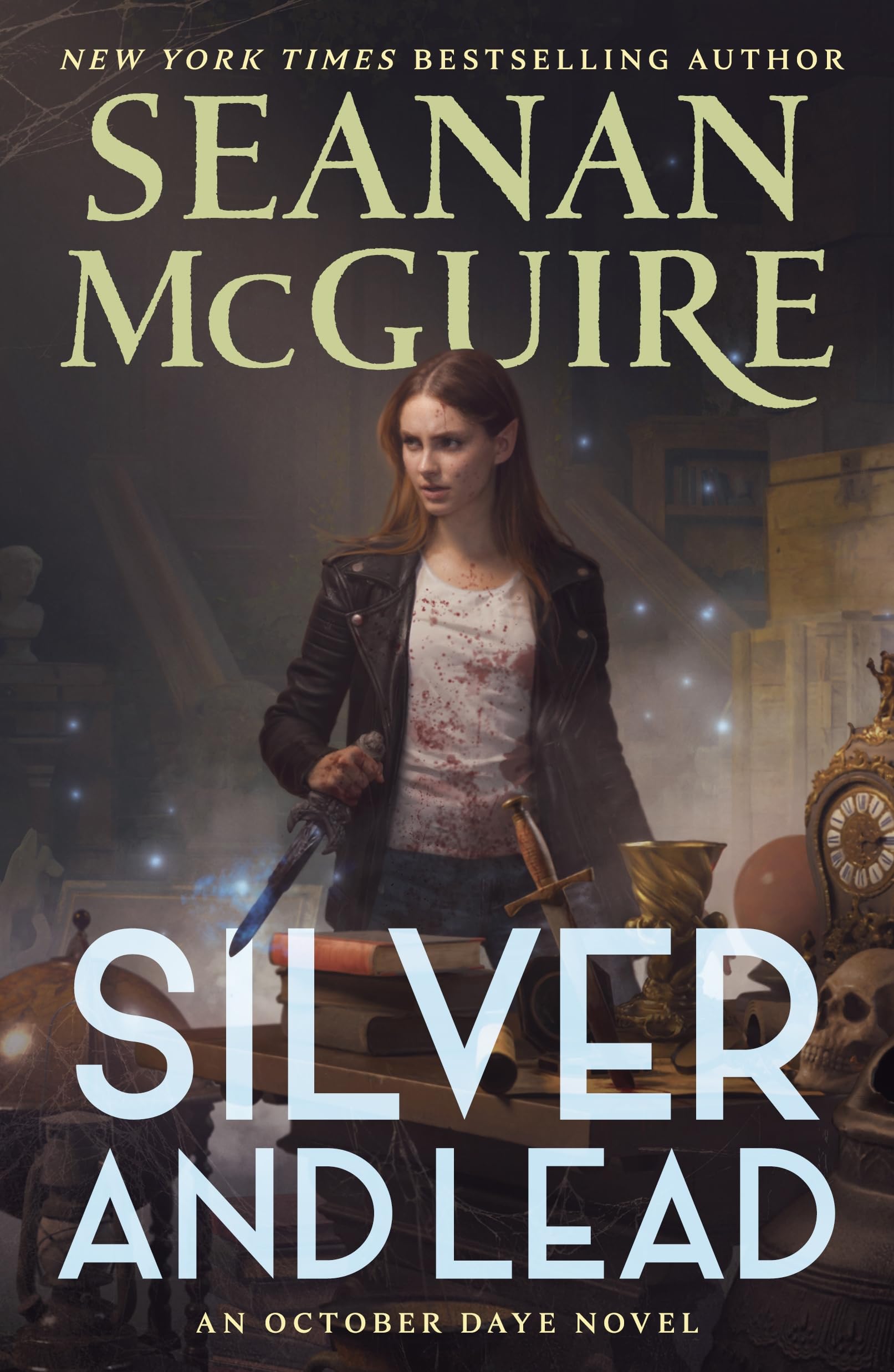
Seanan McGuire’s New York Times bestselling and Hugo Award-nominated October Daye series continues as Toby Daye is thrust once again …

This is just a story. It can't hurt you anymore.
Since she was three …
I did like this book, but not as much as I'd expected to.
At the level of plot, it's like Invasion of the Body Snatchers. On a character level, it's about trying to go through life knowing you're different from everyone around you. And thematically, it's about friends and family vs. the world, and vs. each other, and figuring out where the lines are between who you can trust and who you can't.
The prologue is not for the squeamish. But the rest of the novel is more eerie sci-fi and less horror.
It's mostly told from Stasia's (the plant person) point of view. Most of the other characters aren't...well, maybe I shouldn't say "fleshed out" when half of them are plant people, but while Stasia's puzzlement over their motivations supports the story thematically, it makes it less engaging. Though there is an interesting shift in …
I did like this book, but not as much as I'd expected to.
At the level of plot, it's like Invasion of the Body Snatchers. On a character level, it's about trying to go through life knowing you're different from everyone around you. And thematically, it's about friends and family vs. the world, and vs. each other, and figuring out where the lines are between who you can trust and who you can't.
The prologue is not for the squeamish. But the rest of the novel is more eerie sci-fi and less horror.
It's mostly told from Stasia's (the plant person) point of view. Most of the other characters aren't...well, maybe I shouldn't say "fleshed out" when half of them are plant people, but while Stasia's puzzlement over their motivations supports the story thematically, it makes it less engaging. Though there is an interesting shift in perspective as the advance vanguard becomes less human and more plant.
I also can't help but think of this as a more cynical, post-COVID take on some of the same themes as the Newsflesh trilogy. The author remarked recently that she no longer has the faith in humanity that we'd band together against an existential threat, and that echoed through my mind a lot while I was reading this.
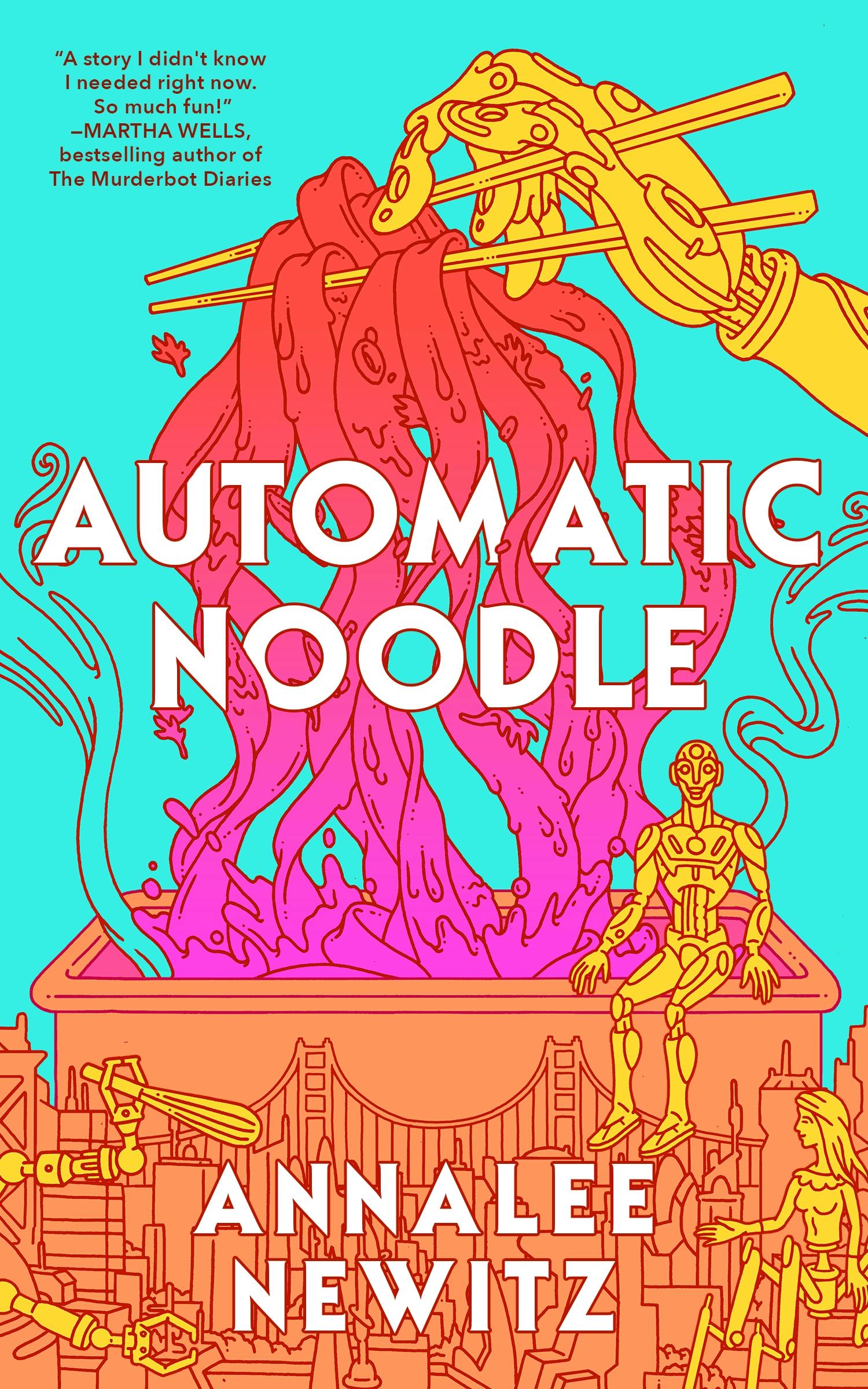
From sci-fi visionary and acclaimed author Annalee Newitz comes Automatic Noodle, a cozy near-future novella …
Automatic Noodle is a short, joyful tale of creating the future you want out of the present you've been stuck with.
The main robots are all well-drawn, individual characters: The octopus-like search-and-rescue bot whose chemical sensors were perfect for analyzing taste and smell, who has fond memories of the falafel truck they worked at after the war (and is seriously into speculating cryptocurrency on the side). The bot with articulated arms and hands, who wants to make something worthwhile with them. The former bank teller, partly humaniform, who becomes more comfortable expressing her inner robot-ness as she explores logistics and supply chains. And the former combat robot, who finds himself tired of working in management and wants to get back into protecting people (both human and robot) and the restaurant, and discovers there are more ways to do that than just muscle (or rather servos) and ammo. The sentient …
Automatic Noodle is a short, joyful tale of creating the future you want out of the present you've been stuck with.
The main robots are all well-drawn, individual characters: The octopus-like search-and-rescue bot whose chemical sensors were perfect for analyzing taste and smell, who has fond memories of the falafel truck they worked at after the war (and is seriously into speculating cryptocurrency on the side). The bot with articulated arms and hands, who wants to make something worthwhile with them. The former bank teller, partly humaniform, who becomes more comfortable expressing her inner robot-ness as she explores logistics and supply chains. And the former combat robot, who finds himself tired of working in management and wants to get back into protecting people (both human and robot) and the restaurant, and discovers there are more ways to do that than just muscle (or rather servos) and ammo. The sentient car doing delivery gigs who has a thing for old media and will tell you exactly what's wrong with the offensive robot stereotypes in, say, Transformers.
Content warning Mild spoilers for the first chapter
Earth's "NVA" setup of constantly tormenting one person for the supposed benefit of society brings to mind Omelas, but several things make it worse: - It's clearly a deliberate choice, not a "necessary" evil. - They've trained the populace to enjoy NVA's torment, unlike Omelas where it's a secret shame. It's more like the daily two minutes of hate. - They keep swapping in new clones of the same person, using the threat of "She might be you!" as part of keeping women down. - The society isn't even that great anyway. At least with Omelas you can understand why people would want to rationalize their complicity in the system. That's the point of the story, after all. Here? it's explicitly fascist, though the characters from Earth noticeably don't say so until they're light-years away from it.

I just discovered there's a third book in the series. Looking forward to how this picks up on the threads in the epilogue from Interference.
I just discovered there's a third book in the series. Looking forward to how this picks up on the threads in the epilogue from Interference.

Over two hundred years after the first colonists landed on Pax, a new set of …
An intriguing followup to Semiosis that weaves several drastically different sentient species (both plant and animal) into a story about factions, community, freedom, communication and war.
In the centuries since the human colonists left for Pax, Earth's civilization collapsed and a fascist patriarchy took control and has rebuilt things to the point that they can check in on some of those outer-space colonies from before the fall.
Like the first book, each chapter is told from a different character's point of view (including Stevland, of course!), though this time around it's all focused on the arrival of the new expedition and the events leading up to it. The psychology of the bamboo's and the Glassmakers' perspectives is notably different from the humans', and of course each species has its factions, and each faction has its priorities, and each person has what they do and don't know and assume. …
An intriguing followup to Semiosis that weaves several drastically different sentient species (both plant and animal) into a story about factions, community, freedom, communication and war.
In the centuries since the human colonists left for Pax, Earth's civilization collapsed and a fascist patriarchy took control and has rebuilt things to the point that they can check in on some of those outer-space colonies from before the fall.
Like the first book, each chapter is told from a different character's point of view (including Stevland, of course!), though this time around it's all focused on the arrival of the new expedition and the events leading up to it. The psychology of the bamboo's and the Glassmakers' perspectives is notably different from the humans', and of course each species has its factions, and each faction has its priorities, and each person has what they do and don't know and assume. (The chapter in which the Earth expedition arrives at the colony has the narrator repeatedly making and revising assumptions.)
And there are more factions in a war fought on plant timescale.
Despite it being more tightly compressed in time, it feels less focused than the first book. There's a side expedition late in the story that's both necessary thematically and narratively awkward. I'm not sure how I feel about the epilogue as an epilogue, but as I put the finishing touches on this review I've just discovered that Burke wrote some related short stories set during Semiosis...and a third book that picks up on those threads and was published just last year.
From sci-fi visionary and acclaimed author Annalee Newitz comes Automatic Noodle, a cozy near-future novella about a crew of abandoned …
I think this may have been the first place I saw the "great filter" concept named (the idea that somewhere between a planet having the conditions for life and a spacefaring civilization there's at least one step that's extremely unlikely or difficult). They'd found worlds that had nuked themselves into oblivion and others that were simply abandoned (though the human dying of cancer comes up with a compelling theory as to what happened to them), but only three that were still alive.
As an avid science-fiction reader and viewer, I'd definitely encountered the Fermi Paradox by then (given how huge and old the universe is, there's got to be more intelligent life out there somewhere, so why haven't we seen it?), as well as the idea of advanced species sending out berzerkers to destroy potential rivals before they have a chance to develop. (Liu Cixin's "Dark Forest" …
I think this may have been the first place I saw the "great filter" concept named (the idea that somewhere between a planet having the conditions for life and a spacefaring civilization there's at least one step that's extremely unlikely or difficult). They'd found worlds that had nuked themselves into oblivion and others that were simply abandoned (though the human dying of cancer comes up with a compelling theory as to what happened to them), but only three that were still alive.
As an avid science-fiction reader and viewer, I'd definitely encountered the Fermi Paradox by then (given how huge and old the universe is, there's got to be more intelligent life out there somewhere, so why haven't we seen it?), as well as the idea of advanced species sending out berzerkers to destroy potential rivals before they have a chance to develop. (Liu Cixin's "Dark Forest" is a variation on this where the advanced species aren't actively looking, so you might be able to escape notice if you're very, very quiet.)

Calculating God is a 2000 science fiction novel by Robert J. Sawyer. It takes place …
It's been a while, but Calculating God sticks in my head as an interesting exploration: What if there is scientific evidence out there for a supreme being, but to find it you have to correlate knowledge from multiple inhabited worlds across the galaxy?
The specific situation is a pattern of mass extinctions that's common on all known inhabited worlds, and a multispecies expedition has come to Earth to cross-check our fossil record and see if it matches too. (It does, of course, which is what sets the rest of the book in motion.)
Like a lot of Sawyer's more philosophical science-fiction, it's mostly talking and thinking and figuring things out. There's not a whole lot of action, and I remember thinking the young-earth-creationist vandals were too much of a caricature to take seriously. (I suspect if I read it again now, they'd seem subtle compared to the pundits …
It's been a while, but Calculating God sticks in my head as an interesting exploration: What if there is scientific evidence out there for a supreme being, but to find it you have to correlate knowledge from multiple inhabited worlds across the galaxy?
The specific situation is a pattern of mass extinctions that's common on all known inhabited worlds, and a multispecies expedition has come to Earth to cross-check our fossil record and see if it matches too. (It does, of course, which is what sets the rest of the book in motion.)
Like a lot of Sawyer's more philosophical science-fiction, it's mostly talking and thinking and figuring things out. There's not a whole lot of action, and I remember thinking the young-earth-creationist vandals were too much of a caricature to take seriously. (I suspect if I read it again now, they'd seem subtle compared to the pundits and politicians making noise today.)
There's a deus ex machina close to the end, but it's sort of the point of the book, and an epilogue that pulls together several of the "why is this aspect of life universal???" questions the characters had been trying to figure out.

In 2059 two very different groups have their minds uploaded into a quantum computer in …
A short, fast tale of two groups reawakening after the fall of civilization, built around the premise that you need to keep a frozen person's consciousness active in VR...and there are very different reasons you might put people into cryo storage and a time-adjusted simulation. Not a lot of story, mainly character studies.
The everything-is-an-interview convention gets awkward after a while, at least as prose. But it wouldn't surprise me if it works better with the actual voice cast.
A short, fast tale of two groups reawakening after the fall of civilization, built around the premise that you need to keep a frozen person's consciousness active in VR...and there are very different reasons you might put people into cryo storage and a time-adjusted simulation. Not a lot of story, mainly character studies.
The everything-is-an-interview convention gets awkward after a while, at least as prose. But it wouldn't surprise me if it works better with the actual voice cast.
From sci-fi visionary and acclaimed author Annalee Newitz comes Automatic Noodle, a cozy near-future novella about a crew of abandoned …