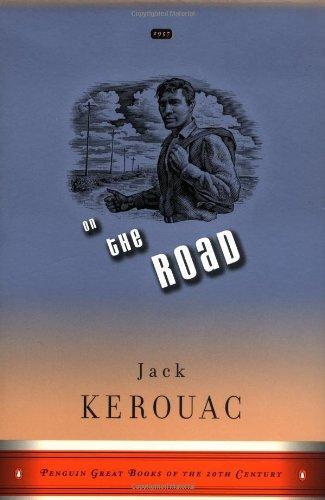
On the Road is a 1957 novel by American writer Jack Kerouac, based on the travels of Kerouac and his friends across the United States. It is considered a defining work of the postwar Beat and Counterculture generations, with its protagonists living life against a backdrop of jazz, poetry, and drug use. The novel is a roman à clef, with many key figures of the Beat movement, such as William S. Burroughs (Old Bull Lee), Allen Ginsberg (Carlo Marx), and Neal Cassady (Dean Moriarty) represented by characters in the book, including Kerouac himself as the narrator Sal Paradise. The idea for On the Road, Kerouac's second novel, was formed during the late 1940s in a series of notebooks, and then typed out on a continuous reel of paper during three weeks in April 1951. It was published by Viking Press in 1957. The New York Times hailed the book's appearance …
On the Road is a 1957 novel by American writer Jack Kerouac, based on the travels of Kerouac and his friends across the United States. It is considered a defining work of the postwar Beat and Counterculture generations, with its protagonists living life against a backdrop of jazz, poetry, and drug use. The novel is a roman à clef, with many key figures of the Beat movement, such as William S. Burroughs (Old Bull Lee), Allen Ginsberg (Carlo Marx), and Neal Cassady (Dean Moriarty) represented by characters in the book, including Kerouac himself as the narrator Sal Paradise.
The idea for On the Road, Kerouac's second novel, was formed during the late 1940s in a series of notebooks, and then typed out on a continuous reel of paper during three weeks in April 1951. It was published by Viking Press in 1957.
The New York Times hailed the book's appearance as "the most beautifully executed, the clearest and the most important utterance yet made by the generation Kerouac himself named years ago as 'beat,' and whose principal avatar he is." In 1998, the Modern Library ranked On the Road 55th on its list of the 100 best English-language novels of the 20th century. The novel was chosen by Time magazine as one of the 100 best English-language novels from 1923 to 2005.
Den var fin, og litt det jeg lette etter da jeg bestemte meg for å lese den. Altså, noe i samme gate, eller hvertfall nabolag som Hunter S. Thompson sine bøker. Samtidig synes jeg nok boken dro litt ut på slutten, og gledet meg egentlig til å bli ferdig og å kunne begynne på neste.
That was it. I closed the book, talked to a friend about it, threw a few things into a backpack, and we bought a ticket for the first train leaving the station. It was around ’91 or ’92, and it’s an experience I’ll never forget. It was a book that marked entire generations, but nowadays, when everything is so certain and just a click away, that spirit seems to be gone. Until one day. Freedom and Fado.
That was it. I closed the book, talked to a friend about it, threw a few things into a backpack, and we bought a ticket for the first train leaving the station. It was around ’91 or ’92, and it’s an experience I’ll never forget.
It was a book that marked entire generations, but nowadays, when everything is so certain and just a click away, that spirit seems to be gone.
Until one day.
Freedom and Fado.
This is my 2nd attempt to read this. My first was during college, where I crashed out about halfway through, during the part of the book where Sal Paradise is living with Terry and picking cotton. At the time I didn't find much of interest in the book, and I was too focused on other things. Now older, I decided to give it another try. I wasn't blown away, unfortunately a lot of what was unique about the work has been lost since it came out (it's frank depiction of sexuality, drug usage, infidelity, etc).
However I think that there are still thing's of interest in the book. Kerouac captures the manic energy of youth. Paragraphs fly through locations and people with a freewheeling style, creating a kind of free-form narrative as Kerouac as Sal drive through a United States that has long since disappeared. Everything seems important, small cities …
This is my 2nd attempt to read this. My first was during college, where I crashed out about halfway through, during the part of the book where Sal Paradise is living with Terry and picking cotton. At the time I didn't find much of interest in the book, and I was too focused on other things. Now older, I decided to give it another try. I wasn't blown away, unfortunately a lot of what was unique about the work has been lost since it came out (it's frank depiction of sexuality, drug usage, infidelity, etc).
However I think that there are still thing's of interest in the book. Kerouac captures the manic energy of youth. Paragraphs fly through locations and people with a freewheeling style, creating a kind of free-form narrative as Kerouac as Sal drive through a United States that has long since disappeared. Everything seems important, small cities and towns are described as part of a grand view of the US. People pop in and out the narrative frequently, but everyone and everything has this sense of importance placed on them as being part of the whole of America.
The novel is not just about America as grand object, but also with youth and growing up. One of the many threads that makes up the work follows Kerouac's friend Neal Cassady as Dean Moriarty going from beloved member of the disparate and wide flung friend group to being seen as a user and a childish man unable to actually engage with the people he's with. And while Sal is much more sympathetic and even entranced by Dean, even he eventually has his tipping point.
My main criticism of the book, however, is that I am nowhere near as entertained or entranced by Dean's antics as Kerouac is. His nonsensical and pseudo-intellectual posturing and dialogue just floats past me, and it's a vision of youth and life that I don't really have any connection to. As well, the book starts to drag by the end as even the energetic prose starts to run out of steam. This doesn't even get into the casual misogyny and racism Kerouac throws around, and is at it's worst during the last part when the pair travels to Mexico.
My main takeaway is that I can see why this book was so important to 20th century literature and it has flashes of genius, but it's not a favorite, and I don't think you'll necessarily be missing anything if you decide to put it down.
There are some interesting facts about this book that attracted me to read it. I first heard about it from Cory Doctorow's Little Brother. Then I found this page (dennismansker.com/ontheroad.htm) useful to put in context the journeys distance and the type of cars. The reading was entertaining and it is an interesting analysis on friendships.
There are some interesting facts about this book that attracted me to read it. I first heard about it from Cory Doctorow's Little Brother. Then I found this page (dennismansker.com/ontheroad.htm) useful to put in context the journeys distance and the type of cars. The reading was entertaining and it is an interesting analysis on friendships.
I promise myself that I'll give at least 100 pages on any book I've read. And because I've heard so much about this one, I went a bit farther. But yikes, I had to quit--just couldn't get into it anymore.
There are some things I can appreciate with this book, and others I just can't grasp. I can appreciate the unique writing style, in the pacing of the story. There's something happening--or even very much NOT happening--on each page. What I can't grasp is the inconsistencies between thoughts and dialogue, how Sal, the narrator will be giving Dean's (or anyone's perspective) and it abruptly goes into the character talking. I can't word it better, and I barely got the gist of the dialogue.
All in all, I guess I tried to understand the characters, but they were just too much and not enough at the same time, as …
I promise myself that I'll give at least 100 pages on any book I've read. And because I've heard so much about this one, I went a bit farther. But yikes, I had to quit--just couldn't get into it anymore.
There are some things I can appreciate with this book, and others I just can't grasp. I can appreciate the unique writing style, in the pacing of the story. There's something happening--or even very much NOT happening--on each page. What I can't grasp is the inconsistencies between thoughts and dialogue, how Sal, the narrator will be giving Dean's (or anyone's perspective) and it abruptly goes into the character talking. I can't word it better, and I barely got the gist of the dialogue.
All in all, I guess I tried to understand the characters, but they were just too much and not enough at the same time, as if they're confusing the hell out of themselves just by breathing, and we're experiencing that, too. If that was the goal, I guess the mission's accomplished. But I couldn't stick with it because it felt like "go on a trip on a whim, have crap happen, get in the dumps, go home, wash-rinse-repeat." I'd always read that this book was so iconic, but I guess I can't see it.
Who knows? Might be your cup of tea, too confusing to be mine (and I don't like feeling like I need drugs to understand what's going on, as some have suggested).
2.5 stars would be ideal. Mediocre. The start was only mildy interesting, but then the story got very repetitious. The main character kept doing essentially the same things over and over.
The road that leads nowhere. I am not in the habit of criticizing books for the character of their characters, but in this case it is difficult not to do so since the book is practically autobiographical.
The inconsequence of the whole story, the improbable motivations of the characters to remain in constant movement and change and the glorification of poverty and suffering of those who cannot abandon their cycle of misery were by far the factors that bothered me the most and that made almost impossible to finish this book. Certainly it's a book which marks a generation and that will have a special place in the heart of those who lived the beat movement, but personally I was unable to foster any compassion for any of the characters and the story seemed to me to be a diversion of rich boys, rebels without a cause. The pseudo-neuroses of …
The road that leads nowhere. I am not in the habit of criticizing books for the character of their characters, but in this case it is difficult not to do so since the book is practically autobiographical.
The inconsequence of the whole story, the improbable motivations of the characters to remain in constant movement and change and the glorification of poverty and suffering of those who cannot abandon their cycle of misery were by far the factors that bothered me the most and that made almost impossible to finish this book. Certainly it's a book which marks a generation and that will have a special place in the heart of those who lived the beat movement, but personally I was unable to foster any compassion for any of the characters and the story seemed to me to be a diversion of rich boys, rebels without a cause. The pseudo-neuroses of the poet Allen Ginsberg are practically impossible to digest.
I didn't hate it, but I didn't get it either. It's not a book you read for the plot, because there isn't really any to speak of. As I understand it, it's the thrill of the travel that's supposed to be the thing that gets you excited about this book, and while I enjoyed the descriptions of the continent from up close, overall, it didn't sound enjoyable or attractive to me at all. For example, descriptions of the pleasantness of being caked with dead bugs and covered in mosquito bites did not resonate with me at all.
My lack of enthusiasm might be explained by the fact that I haven't really heard of the "Beat Generation" before, and that while I enjoy visiting new and unfamiliar places, I do feel ready to go back home relatively quickly. In other words: your mileage may vary.
I didn't hate it, but I didn't get it either. It's not a book you read for the plot, because there isn't really any to speak of. As I understand it, it's the thrill of the travel that's supposed to be the thing that gets you excited about this book, and while I enjoyed the descriptions of the continent from up close, overall, it didn't sound enjoyable or attractive to me at all. For example, descriptions of the pleasantness of being caked with dead bugs and covered in mosquito bites did not resonate with me at all.
My lack of enthusiasm might be explained by the fact that I haven't really heard of the "Beat Generation" before, and that while I enjoy visiting new and unfamiliar places, I do feel ready to go back home relatively quickly. In other words: your mileage may vary.
This is supposed to be such a seminal book, I was quite looking forward to it - a book that defined a generation, and blah blah blah.
Well, controversial opinion coming - this book is nonsense. I willed myself to finish it, but there's nothing to be gained from pulling yourself through this tangential and dull travel journal. The only character who is focused on is Dean, and even then we don't really understand why he's like what he is, or get any detail. We're told very little about anything else, and even if you were reading this to understand American history, there's precious little here. An utter waste of your time, I'm afraid. Sorry, and all that.
This is supposed to be such a seminal book, I was quite looking forward to it - a book that defined a generation, and blah blah blah.
Well, controversial opinion coming - this book is nonsense. I willed myself to finish it, but there's nothing to be gained from pulling yourself through this tangential and dull travel journal. The only character who is focused on is Dean, and even then we don't really understand why he's like what he is, or get any detail. We're told very little about anything else, and even if you were reading this to understand American history, there's precious little here. An utter waste of your time, I'm afraid. Sorry, and all that.
I left my copy of this unfinished in a phone booth at Hastings railway station in about 1966. I had found the style tedious and the characters unappealing. Neal Cassidy had a broken childhood, and became a broken man. Jack Kerouac seems to have stolen his voice, but not to have heard the driving terror that underlay it. Like Ginsberg, he wrote kitsch and called it rebellion.
I left my copy of this unfinished in a phone booth at Hastings railway station in about 1966. I had found the style tedious and the characters unappealing. Neal Cassidy had a broken childhood, and became a broken man. Jack Kerouac seems to have stolen his voice, but not to have heard the driving terror that underlay it. Like Ginsberg, he wrote kitsch and called it rebellion.
This is a book about self-involved, selfish people who treat each other, and others, terribly. They don't so much as learn anything as they do simply get tired. I spent the entire book wondering how all the people they used, the people they stole from, the women they abandoned, were getting on; how they coped with the fallout from interacting with the main characters. I'd much rather read the dozens of books from their points of view.
This is a book about self-involved, selfish people who treat each other, and others, terribly. They don't so much as learn anything as they do simply get tired. I spent the entire book wondering how all the people they used, the people they stole from, the women they abandoned, were getting on; how they coped with the fallout from interacting with the main characters. I'd much rather read the dozens of books from their points of view.
Self-centered dude goes on a power road trip. You don't need to read this.
This was mentioned in the book Little Brother and some friends have mentioned this book before. I get the appeal of being on a road trip, but the perspective in this book was a little too ego-stroking.
Self-centered dude goes on a power road trip. You don't need to read this.
This was mentioned in the book Little Brother and some friends have mentioned this book before. I get the appeal of being on a road trip, but the perspective in this book was a little too ego-stroking.
This book was a fun read. Sal and Dean travel around without a care in the world and "make it" with girls.
The 2 adventurers in this book know what they want and do everything it takes to get it. They put the effort into life it takes to have the adventurous life everyone yearns for.
I finished reading this book with a taste for the road and even bought an atlas to put in my car.
Some chapters, such as the first chapter, were fairly nonsensical to me, but I interpreted that as a constant wavering of sanity going in-and-out. The rest of the book made up for it with interesting stories and details.
Spoiler: The book is split into 5 parts. Each part focusing on one leg of the trip. Always ending up back at New York.
Dean is crazy. Like bat-shit crazy. At first I couldn't quite …
This book was a fun read. Sal and Dean travel around without a care in the world and "make it" with girls.
The 2 adventurers in this book know what they want and do everything it takes to get it. They put the effort into life it takes to have the adventurous life everyone yearns for.
I finished reading this book with a taste for the road and even bought an atlas to put in my car.
Some chapters, such as the first chapter, were fairly nonsensical to me, but I interpreted that as a constant wavering of sanity going in-and-out. The rest of the book made up for it with interesting stories and details.
Spoiler: The book is split into 5 parts. Each part focusing on one leg of the trip. Always ending up back at New York.
Dean is crazy. Like bat-shit crazy. At first I couldn't quite tell, he just seemed a little selfish, but the amount of selfish he went to says something else to me. You don't leave someone in Mexico because they got sick. Dean obviously didn't have a care in the world for anyone but himself. Constantly marrying people and divorcing. I was getting fed up with him by the end of the book.
There is also a strange attraction to early-teen girls. I don't know what this is about. They'll see some 12 or 14 year old and spend a few pages talking about how they want to "make it" with her. Seriously, entire pages were spent describing the sex appeal of early-teen girls.