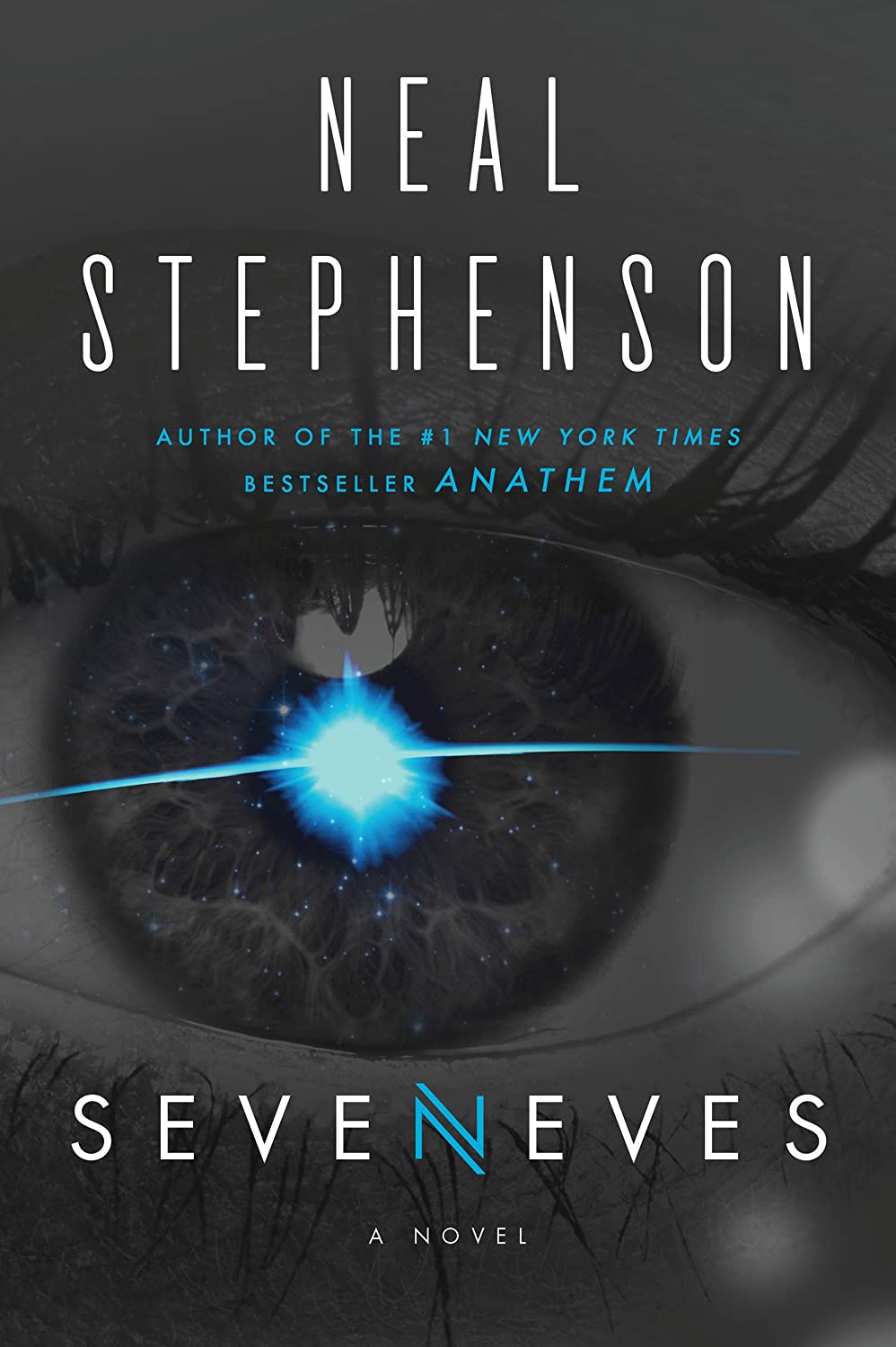

Levi reviewed Seveneves by Neal Stephenson
None
5 stars
What if an object hit the Moon with enough force that it broke apart? How would that affect life on Earth as we know it?
That’s the central premise of Seveneves, and what follows is one of the greatest legendary epics in all of hard science fiction. This is a book that swings for the fences, then builds a space elevator to go higher. It is ruthless in its scientific rigor, relentless in its ideas-per-page density, and somehow still profoundly human. What a masterpiece.
If you're the kind of reader who loves idea-dense sci-fi, real physics, moral complexity, and long-form worldbuilding on the timescale of thousands of years—this book will ruin you for lesser books.
The moon explodes on page one. But rather than immediate chaos, Stephenson plays it cool. Earth’s gravity and orbital physics don’t care whether the moon is in one piece or seven—so for a while, nothing …
What if an object hit the Moon with enough force that it broke apart? How would that affect life on Earth as we know it?
That’s the central premise of Seveneves, and what follows is one of the greatest legendary epics in all of hard science fiction. This is a book that swings for the fences, then builds a space elevator to go higher. It is ruthless in its scientific rigor, relentless in its ideas-per-page density, and somehow still profoundly human. What a masterpiece.
If you're the kind of reader who loves idea-dense sci-fi, real physics, moral complexity, and long-form worldbuilding on the timescale of thousands of years—this book will ruin you for lesser books.
The moon explodes on page one. But rather than immediate chaos, Stephenson plays it cool. Earth’s gravity and orbital physics don’t care whether the moon is in one piece or seven—so for a while, nothing much happens. People host viewing parties. They nickname the fragments: “Lumpy,” “Mr. Spinny,” "Potatohead", etc. The public relaxes.
Then, two weeks later, one piece hits another, causing one of them to split. And then a few days later it happens again and nother piece splits. A slow chain reaction has been set off—a cascading series of collisions, fragmentation, more collisions—and models predict that after about 24 months the reaction will explode into something they dub The Hard Rain: a catastrophic shower of molten lunar fragments that will bombard Earth continuously for the next 5,000 years.
The surface of the Earth is going to be sterilized. For a very long time.
Humanity has two years to prepare.
What unfolds is a desperate, all-hands global effort to launch as many people into space as possible. The story centers on “Izzy,” the International Space Station, and how it becomes the nucleus of an improvised orbital ark. You feel the sheer logistical madness of it all: EVA shifts running 16 hours a day, inflatable sleeping bubbles tethered in vacuum for Russian cosmonauts dying by the dozens just to build more habitats for others.
One of them, Tekla, has her bubble ruptured and must be rescued in an incredible zero-G sequence involving chain physics, robotic mining snakes, and a near-fatal decompression. Best EVA rescue I’ve ever read.
And that’s just Act I.
Stephenson excels at conveying technical detail without killing the pace. I feel like I learned more about orbital mechanics, comet propulsion, chain dynamics, radiation shielding, swarm robotics, genetic engineering, and the sociology of survival than in any other five books combined.
There’s a scene where a nuclear reactor is strapped to a comet and turned into a propulsion system using robot swarms—and somehow, it feels both insane and totally plausible. I love that the ISS is essentially humanity’s ark. I love that there’s a redneck, duct-taped ship called Ymir hurling through space, operated by a man named Sean Probst, who just might be the most badass asteroid miner in sci-fi history.
Through it all, Stephenson writes a wide variety of characters with different personality types who who all think. Real, nuanced, incredibly intelligent people. Even when they’re making tragic mistakes or being bureaucratic nightmares (hello, JBF—you made my blood boil), they feel alive and believable. Dinah and Ivy’s father-daughter Morse code conversations between Earth and orbit are among the most poignant bits of near-future writing I’ve read.
Eventually, the Hard Rain comes. Earth dies. And in its wake, only a fraction of the evacuees survive—mostly women. In fact, at one point, the entire surviving human race is reduced to seven women (dubbed the Seven Eves), each forced to confront the most profound question imaginable: If you could choose the traits of your descendants, what kind of people would you make?
In order to create the needed genetic diversity, they have to introduce highly technological artificial means of impregnating the women with zygotes (fertilized eggs) that are of carefully selected phenotypes based on their bank of phenotypes taken from the human race. Since the process is already highly artificial, it opens up the Pandora's Box question of: how much tampering should we allow ourselves to do?
How much tampering with the human genome should be allowed?
You can select for physical traits; what about personality traits? What about intelligence? What about aggression?
This opens up the problem of, different people will disagree about what traits are "good" and "bad". One of the Eves thinks aggression is actually really important for the survival of the human race; that aggression is a trait of free thinkers and bold leaders. Another Eve thinks that her bipolar disorder is not such a wholly bad thing as it has been labeled. Another argues that her depression is part-and-parcel of being the kind of leader who thinks about the future a lot.
How will they possibly ever agree and decide on how much tampering is acceptable?
Moira, the brilliant geneticist among them, proposes a compromise: each woman gets one trait she can engineer into her line. It’s elegant. Democratic. Dangerous. What unfolds is a rich thought experiment in personality, morality, and design. One of the Eves values aggression—believing it essential for survival. Another values compassion. Another physicality. Etc.
Five thousand years later, we arrive in a fully realized posthuman future. The human race is now split into seven races, some of which include subraces. The seven races live (mostly) in an orbital ring they have built out of the fragments of the Moon that naturally decayed into a ring shape. The ring is divided between two ideological blocs known as Red and Blue. Their names echo not just the factions of the Seven, but different modes of thinking, of surviving.
Earth, long sterile, has begun to bloom again.
Kath Two, a scout from the Moiran line (whose people undergo epigenetic shifts in response to major life events), explores the resettled surface in her glider. One day, she glimpses something impossible: a humanoid who is not one of the Seven Races. A mystery is born.
This kicks off the second story: a mission where a "Seven"—a team of one member from each race—is sent to do something deemed of historical significance to all of humanity. It feels exactly like a D&D part that's been put together—but Stephenson makes it feel fresh, thrilling, even mythic in scale. I won't even get into all the awesome characters in the party but just suffice it to say, it's emotionally satisfying to have the idea seeded from the beginning, that the human diaspora split into different evolutionary branches, finally coming full circle and being used in a really stimulating way.
Now, what are these Seven going to discover? Who are these other non-Seven people? Well, earlier in the story when I said everyone that survived humanity went to space--I lied. Not quite everyone. There were also a few who retreated underground—deep into sealed environments beneath Earth’s surface—developing their own civilization, cut off completely from the rest of humanity. The revelation of their survival, and the slow unwinding of how they endured for five thousands years in a sealed environment, is handled with care and suspense. Their entire society has been watching the sky, hiding, waiting. Until now.
There’s a final twist I won’t spoil. But it lands. (And for those who have read it; two words: Sonar. Taxlaw. What a hilarious character! If you know, you know.)
And there's so much cool tech in this era of the story. There's mobile space elevators, there's gliders, there's a thing called a Thor which can extract people from the ground all the way up into high orbit in seconds...the list goes on. I swear, Neal Stephenson packed every awesome idea known to man into one giant tome. As a writer, I love trying to dissect how Stephenson juggles physics, psychology, and plot—without ever letting the science kill the story.
The ending reaffirms something I kept feeling all the way through: this book is not just about survival. It’s about inheritance—of genes, cultures, and meaning. It’s about what it means to be human, and what parts of us we dare to design, or destroy, or save.
While Seveneves is certainly an intellectual feast, it’s also brutal. There is no room for politics in space. One stupid decision costs lives. Heroism is measured in EVA suit hours and radiation exposure. One man chooses to die the most miserable death possible—extreme radiation poisoning—to save others. And you feel it. The ache, the necessity, the cost.
Stephenson doesn’t shy away from that truth. He makes you sit with it, learn from it, and then keeps the story going.
Seveneves is perfect for anyone who enjoys hard science fiction, people who love learning, anyone who's wanted to know more about orbital mechanics / the physics of chains / genetic engineering / everything about the universe life and everything, and all people who love big ideas.
If the engineered future of Seveneves stirred your thoughts on identity, morality, and what we dare to become—this is a short story I wrote about a man who uploads his mind to escape addiction and finds himself locked in a room with a man sent to kill him for it.
https://levihobbs.substack.com/p/the-wife-and-the-terrorist
----------
One last thing. Here's a quiz, just for the sheer fun of it. Which of the Seven Races would you be? Bonus points if you respond with why.
1. Moiran – Thoughtful, scientific, and adaptable.
Capable of radical epigenetic shifts in response to life events. Often serve as scouts, analysts, and visionaries—versatile and calm under pressure.
2. Aïdan Line – Politically savvy, genetically diverse, and divisive.
This is the only race with multiple subraces. Which Aïdan are you?
2A. Aretaic – Tall, charismatic, and persuasive. The public face of Red. Natural leaders, media figures, and diplomats—designed to stand in the spotlight.
2B. Beta – Balanced and ubiquitous. General-purpose humans with no single specialization. Reliable, steady, and often underestimated.
2C. Neoander – Powerful, stocky, and cunning. Inspired by Neanderthal traits. Built to endure and outmaneuver in extreme environments.
2D. Jinn – Highly intelligent and logical. Enigmatic and rare. Brilliant at abstraction, insight, and systems-level thinking.
2E. Extat – Emotionally volatile, creative, and visionary. Labeled “crazy” by some—but essential to cultural and artistic dynamism.
3. Julian – Melancholic, calculating, and socially adept.
Masters of manipulation, suspicion, and psychological insight. Adept at intelligence work, diplomacy, and long-term scheming.
4. Camite – Nurturing, grounded, and emotionally resilient.
Bred for non-aggression and communal harmony. Often the social glue and caregivers of society. Calm under pressure, generous by instinct.
5. Teklan – Disciplined, stoic, and physically formidable.
Builders, warriors, and systems-maintainers. Teklans thrive under pressure and do what must be done.
6. Ivyn – Intelligent, focused, and introverted.
Engineers, tinkerers, and problem-solvers. Brilliant at design and invention—especially when left alone to work.
7. Dinan – Compassionate, brave, and deeply relational.
Known for their moral clarity, heroic instincts, and fierce loyalty to others. The protectors, negotiators, and idealists of the future.