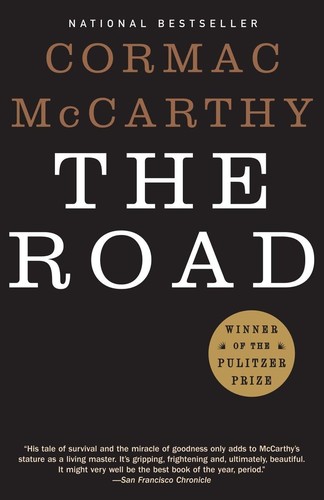
"A father and his son walk alone through burned America. Nothing moves in the ravaged landscape save the ash on the wind. It is cold enough to crack stones, and when the snow falls it is gray. The sky is dark. Their destination is the coast, although they don't know what, if anything, awaits them there. They have nothing; just a pistol to defend themselves against the lawless bands that stalk the road, the clothes they are wearing, a cart of scavenged food - and each other." "The Road is the profoundly moving story of a journey. It boldly imagines a future in which no hope remains, but in which the father and his son, "each the other's world entire," are sustained by love."--BOOK JACKET.
"A father and his son walk alone through burned America. Nothing moves in the ravaged landscape save the ash on the wind. It is cold enough to crack stones, and when the snow falls it is gray. The sky is dark. Their destination is the coast, although they don't know what, if anything, awaits them there. They have nothing; just a pistol to defend themselves against the lawless bands that stalk the road, the clothes they are wearing, a cart of scavenged food - and each other." "The Road is the profoundly moving story of a journey. It boldly imagines a future in which no hope remains, but in which the father and his son, "each the other's world entire," are sustained by love."--BOOK JACKET.
The day-to-day of a father and son in a post-apocalyptic USA. This is falls under my category of books read once for a class and long since forgotten about. The straightforward dialogue between father and son are the best parts.
Are we still the good guys? he said. Yes. We’re still the good guys. And we always will be. Yes. We always will be. Okay.
I made a mistake of reading the rest of this book last night before bed. There was a moment when the man was on a ship and the boy was on the beach, and I wanted to make sure the son would be okay so I kept reading. The momentum from that carried me through the end where about 10 pages before the end I began to cry, and it took a while for me to stop. I felt so much for the father who tried desperately to protect his son.
This book slogs you through a dreary wasteland where a man with a young son cannot risk trusting anyone - where people are cannibals and will take everything from you.
As you follow these two, you feel all the hard choices, disappointments, fears, love. You wonder if death would be better, if it's the right thing to do. You …
I made a mistake of reading the rest of this book last night before bed. There was a moment when the man was on a ship and the boy was on the beach, and I wanted to make sure the son would be okay so I kept reading. The momentum from that carried me through the end where about 10 pages before the end I began to cry, and it took a while for me to stop. I felt so much for the father who tried desperately to protect his son.
This book slogs you through a dreary wasteland where a man with a young son cannot risk trusting anyone - where people are cannibals and will take everything from you.
As you follow these two, you feel all the hard choices, disappointments, fears, love. You wonder if death would be better, if it's the right thing to do. You distrust people and feel shame when the son is more forgiving and loving than you would be.
I found that the way it was written - fairly direct language breifly interspersed with near poetry - was effective. It was immersive and terribly, terribly sad.
The cycles of extreme hardship with respites of protection were an experience for me. If they were in a safe place, I felt like I could relax with them for a moment and it made the suffering they went through feel more painful.
Overall, it was a book that made me grateful to not face those decisions, and it made me profoundly sad for a man who'd tried so hard.
I love post-apocalyptic stories, and this one is very well done. I'd compare it to the likes of "A Canticle for Lebowitz", which is of a high caliber.
I didn't want to put it down, which says something.
The only thing I didn't like was the ending. How do you end a story like this? I wasn't sure how McCarthy would do it, but I took faith that it would be excellent. I was a little disappointed, but it's no reason not to read the book. The ending doesn't hold the book together - each section does that on its own.
I love post-apocalyptic stories, and this one is very well done. I'd compare it to the likes of "A Canticle for Lebowitz", which is of a high caliber.
I didn't want to put it down, which says something.
The only thing I didn't like was the ending. How do you end a story like this? I wasn't sure how McCarthy would do it, but I took faith that it would be excellent. I was a little disappointed, but it's no reason not to read the book. The ending doesn't hold the book together - each section does that on its own.
Bleak and depressing, it tells a tale of what our future could be. The imagery is cold. I needed a warm blanket and a cup of tea while reading it. It's the tale of a father's love, a tale of hope, and a tale of life continuing on.
Cormac McCarthy has a way with words. I could picture every location as they traveled along the road. I could feel every cold wind in my bones, and my stomach was clenched in fear and hunger for our travelers. If you haven't read this book, just do it. It left me changed. 4 1/2 stars.
I thought this book was fantastic.
Bleak and depressing, it tells a tale of what our future could be. The imagery is cold. I needed a warm blanket and a cup of tea while reading it. It's the tale of a father's love, a tale of hope, and a tale of life continuing on.
Cormac McCarthy has a way with words. I could picture every location as they traveled along the road. I could feel every cold wind in my bones, and my stomach was clenched in fear and hunger for our travelers. If you haven't read this book, just do it. It left me changed. 4 1/2 stars.
"Goodness will find the little boy. It always has. It will again."
Ha, ha, ha! McCarthy may be as monotonous as hell, but every once in a while he winks out an hilarious zinger... It was meant to be LOL funny, right? (But I think I'll cry if I find the above in the quotes database.) Alas, as ridiculous as that line was, it wasn't enough to make up for the rest of the tedious puerility.
The fire's inside you, boys, don't you forget it. Happy trails.
"Goodness will find the little boy. It always has. It will again."
Ha, ha, ha! McCarthy may be as monotonous as hell, but every once in a while he winks out an hilarious zinger... It was meant to be LOL funny, right? (But I think I'll cry if I find the above in the quotes database.) Alas, as ridiculous as that line was, it wasn't enough to make up for the rest of the tedious puerility.
The fire's inside you, boys, don't you forget it. Happy trails.
Postapokaliptyczna wizja świata. Ojciec i syn skazani na tułaczkę, w poszukiwaniu lepszego jutra. Powieść oparta głównie na dialogach, które mimo swej prostoty zawierają głęboki sens.
"Droga", jako połączenie powieści drogi, powieści przygodowej oraz horroru jest uznawana za największe arcydzieło Cormaca McCarthy'ego. Przez wiele tygodni była bestsellerem New York Timesa, przyjęto ją także do Klubu Książki Oprah Winfrey. Oprócz wspomnianej Nagrody Pulitzera została również wyróżniona najstarszą angielską nagrodą w dziedzinie fikcji. The Tait Black Memorial Prize.
"Droga to powieść przejmująco sugestywna i niepokojąca, to książka, która ukazuje, co czai się pod warstwą żalu i grozy. Nigdy wcześniej nikt nie opisał zagłady świata w sposób tak przekonujący, zarówno w wymiarze duchowym, jak i fizycznym." (Time)
Postapokaliptyczna wizja świata. Ojciec i syn skazani na tułaczkę, w poszukiwaniu lepszego jutra. Powieść oparta głównie na dialogach, które mimo swej prostoty zawierają głęboki sens.
"Droga", jako połączenie powieści drogi, powieści przygodowej oraz horroru jest uznawana za największe arcydzieło Cormaca McCarthy'ego. Przez wiele tygodni była bestsellerem New York Timesa, przyjęto ją także do Klubu Książki Oprah Winfrey. Oprócz wspomnianej Nagrody Pulitzera została również wyróżniona najstarszą angielską nagrodą w dziedzinie fikcji. The Tait Black Memorial Prize.
"Droga to powieść przejmująco sugestywna i niepokojąca, to książka, która ukazuje, co czai się pod warstwą żalu i grozy. Nigdy wcześniej nikt nie opisał zagłady świata w sposób tak przekonujący, zarówno w wymiarze duchowym, jak i fizycznym." (Time)
Very repetitive, and a little boring. The author is quoted as saying he did not know how the book would end while he was writing it, and I believe him.
Maybe if I were 15 and this were my first postapocalypse novel I'd rave more or at least understand the praise. At my age I just found it clumsy, formulaic, poorly developed. The apocalypse scenario is not credible. Character or relationship growth nonexistent. At the end you feel like you've just plodded wearily along a bleak road without accomplishing or learning anything.
Maybe if I were 15 and this were my first postapocalypse novel I'd rave more or at least understand the praise. At my age I just found it clumsy, formulaic, poorly developed. The apocalypse scenario is not credible. Character or relationship growth nonexistent. At the end you feel like you've just plodded wearily along a bleak road without accomplishing or learning anything.
I think this is where I officially give up. I cannot bring myself to finish reading this story. The language is great but I find no connection to the story being told. It's too much post-apocalyptic dreariness and it makes me depressed just thinking of this book. It's most probably a good book but it turns out maybe I am not the kind of person that reads McCarthy books. I tried.
I think this is where I officially give up. I cannot bring myself to finish reading this story. The language is great but I find no connection to the story being told. It's too much post-apocalyptic dreariness and it makes me depressed just thinking of this book. It's most probably a good book but it turns out maybe I am not the kind of person that reads McCarthy books. I tried.